
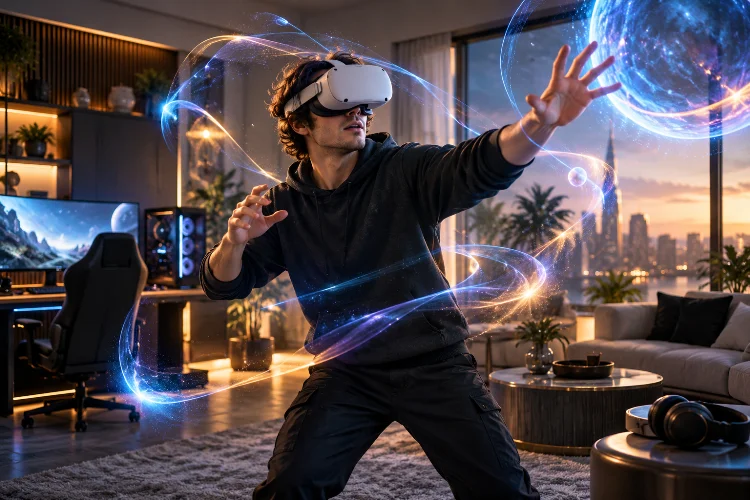
Virtual reality has always promised something traditional gaming cannot completely reproduce: the feeling that you are physically inside the game rather than simply watching it through a screen.
Modern VR is getting much closer to that goal.
Headsets now combine high-resolution displays, precise motion tracking, spatial audio, eye tracking, hand tracking, advanced rendering, and increasingly sophisticated interaction systems. Each technology solves a different part of the immersion problem.
That is why advanced virtual reality technology for immersive gaming is not really about one breakthrough feature. A convincing VR experience emerges when visual, audio, movement, and interaction systems respond together with very little delay.
Performance is especially important. Epic Games notes that maintaining consistent VR frame rates is more critical than in conventional real-time rendering because dropped frames can directly affect user comfort.
The challenge for developers is therefore clear: create richer virtual worlds while keeping the technology fast enough that players stop noticing the headset and start believing in the experience.
1. Modern VR Displays Need More Than High Resolution
Resolution is one of the easiest VR specifications to understand.
More pixels can make text easier to read, reduce visible pixel structure, and improve distant detail. However, resolution alone does not determine how convincing a headset feels.
Refresh rate and frame consistency matter just as much.
A VR headset constantly updates the scene according to head movement. If frames arrive late or inconsistently, the visual world may feel disconnected from physical movement.
That difference can quickly break immerison.
Epic’s VR performance guidance explains that virtual reality applications have demanding frame-time requirements and that CPU, rendering-thread, and GPU workloads all need to stay within their performance budgets.
Unlike a traditional monitor, VR is effectively rendering an interactive view directly around your eyes.
That makes predictable performance a core part of the experience rather than simply a benchmark number.
2. Low-Latency Tracking Makes the Virtual World Feel Stable
When you turn your head in VR, the virtual camera needs to follow almost immediately.
This requires tracking systems to constantly estimate the position and orientation of the headset.
Modern standalone headsets commonly use cameras and onboard sensors to track movement without requiring external base stations for every experience. The same hardware can also contribute to controller, hand, or body tracking.
Latency becomes crucial here.
If physical movement happens noticeably before the image responds, the virtual environment can feel as though it is moving independently from the user.
The best systems make that delay difficult to notice.
Tracking quality also affects interaction. A sword swing, throwing motion, or aiming movement only feels convincing when the virtual controller follows the player’s physical movement with sufficient precision.
In immersive gaming, trackng is therefore not simply an input feature.
It is part of the illusion that the virtual space is physically stable.
3. Eye Tracking Changes How VR Games Render Graphics
Rendering a high-resolution image across the entire VR display is expensive.
Fortunately, human vision provides an interesting optimization opportunity.
We see the greatest detail in the small central region of vision called the fovea. Peripheral vision remains extremely useful for detecting movement and understanding surroundings, but it does not perceive fine detail at the same level.
Foveated rendering takes advantage of this.
Meta’s fixed foveated rendering technology lowers rendering resolution toward the edges of the image to reduce GPU workload. Meta states that this can improve frame rate in fill-rate-limited applications while also lowering power use.
Eye tracking makes the idea even more powerful.
Eye-Tracked Foveated Rendering
Instead of always rendering the center at maximum quality, eye-tracked foveated rendering moves the highest-resolution region according to where the user is actually looking.
Meta describes its implementation as rendering full resolution around the user’s gaze while reducing pixel density in peripheral areas, allowing more aggressive foveation and greater potential GPU savings than fixed foveation.
The player ideally never notices.
That is the clever part.
The GPU performs less work while the area being consciously examined remains detailed.
4. Variable Rate Shading Makes Rendering More Efficient
Foveated rendering belongs to a broader family of techniques that avoid treating every pixel equally.
Variable Rate Shading, or VRS, allows the GPU to apply different shading rates to different parts of an image.
NVIDIA describes VRS as a system capable of changing shading density across regions of a frame. The technology can also work with gaze tracking for foveated VR rendering.
Unreal Engine similarly supports VRS and fixed foveated rendering as XR performance features, along with rendering modes intended to reduce the heavy graphical cost of immersive applications.
Why does this matter for gaming?
Because VR effectively asks the GPU to generate demanding views for the headset while keeping frame timing exceptionally stable.
Saving shading work in areas where players are less likely to notice the difference creates performance headroom.
Developers can spend that budget elsewhere on better lighting, more detailed environments, additional characters, or simply more stable frame rates.
5. Hand Tracking Makes Interaction More Natural
Controllers remain extremely useful for VR gaming because buttons, triggers, and analog sticks provide reliable precision.
But sometimes the most natural controller is your actual hand.
Modern hand-tracking systems use headset cameras and computer vision to estimate finger, hand, and joint positions. Meta explains that its hand-tracking technology processes camera and sensor information using algorithms that recognize hand positions and movements.
This enables interactions such as pointing, pinching, grabbing, and touching virtual objects without holding a traditional controller.
OpenXR also includes standardized hand-tracking functionality that allows applications to locate individual hand joints when compatible hardware and runtimes are available.
Hand tracking is not perfect, however.
Occlusion can occur when one hand blocks another from the headset cameras. Lighting conditions and tracking noise can also affect accuracy. Meta explicitly notes that controllers can remain preferable for experiences requiring a high degree of precision.
The future of immersive gaming will probably involve both methods rather than one completely replacing the other.
6. Haptics Add Physical Feedback to Digital Actions
Seeing your virtual hand grab an object is convincing.
Feeling something happen at the same moment makes the interaction substantially stronger.
Haptic technology translates virtual events into physical feedback.
Current VR controllers commonly use vibration to represent impacts, weapon recoil, collisions, or environmental interactions. Meta’s VR input platform, for example, supports haptic feedback through its Touch controllers alongside tracked controller and hand-based input.
The interesting future lies beyond simple vibration.
More sophisticated haptic devices can potentially simulate resistance, pressure, texture, or force across hands and other parts of the body.
Imagine pulling a virtual bow and feeling increasing resistance, or touching different materials and receiving distinct physical feedback.
The technical challenge is synchronization.
A vibration arriving noticeably after a virtual impact feels artificial. Haptic feedback therefore needs to align closely with tracking, animation, physics, and audio.
Immersion comes from multiple senses agreeing about what just happened.
7. Spatial Audio Expands the World Beyond the Display
VR immersion is not only visual.
Sound can convince the brain that objects exist around you even when they are outside the current field of view.
Spatial audio places sound sources at apparent positions in three-dimensional space.
Meta’s XR audio technology uses head-related transfer functions, or HRTFs, alongside object and ambisonic spatialization and room-acoustics simulation.
These systems mimic some of the cues the human auditory system uses to determine where sounds originate.
If footsteps come from behind and slightly above you, good spatial audio should communicate that direction without requiring you to see the source.
Meta’s current VR audio guidance also emphasizes direction, distance, attenuation, and environmental acoustics as important elements for creating presence.
For gaming, this has practical consequences.
Players can locate enemies, understand environmental scale, and react to events happening outside their vision.
The result is a virtual world that feels larger than the headset display itself.
8. VR Engines Need Aggressive Performance Optimization
VR developers cannot simply build a visually impressive PC game and render the same scene twice without consequences.
The performance requirements are different.
Epic recommends VR-specific optimization approaches including scalable rendering settings, forward rendering, instanced stereo, mobile multiview where appropriate, and careful control of expensive post-processing features.
Why so much optimization?
Because VR performance failures are unusually visible.
A temporary frame-rate drop in a conventional game may produce a short stutter. In a headset, unstable visual timing can affect the relationship between physical head movement and the displayed world.
Developers therefore need performance headroom.
If a headset targets a particular refresh rate, the game should ideally stay within that frame budget even during difficult scenes rather than barely reaching the target under ideal conditions.
High consistancy matters more than impressive screenshots.
9. OpenXR Makes VR Development Less Fragmented
VR hardware comes from multiple manufacturers.
Without common standards, developers would need completely different implementations for every headset, controller, and runtime.
OpenXR helps reduce that fragmentation.
The Khronos Group’s OpenXR standard provides a common API for accessing VR and AR devices.
Unreal Engine describes OpenXR as a royalty-free open standard that provides high-performance access to supported XR platforms and allows developers to build experiences that can run across compatible systems.
The standard has also expanded through extensions covering capabilities such as hand tracking.
This does not mean every headset suddenly provides identical features.
Hardware differences remain.
One device might support eye tracking, while another does not. Some platforms may offer better hand tracking or different controller capabilities.
OpenXR instead gives developers a more common foundation on which those differences can be managed.
That is important for the long-term growth of VR gaming because software becomes less tightly attached to one piece of hardware.
10. The Next Step Is More Invisible Technology
The most advanced VR technology will probably become less noticeable rather than more noticeable.
Better eye tracking means users stop noticing foveated rendering.
Better hand tracking makes virtual interaction feel less like operating an interface.
Improved spatial audio makes players instinctively turn toward sounds.
Lower latency makes the headset disappear from conscious attention.
That is the real objective.
A powerful VR system should not constantly remind players how technologically impressive it is.
It should make them forget they are using technology at all.
Advances in displays, rendering, tracking, haptics, audio, and open standards are gradually pushing VR toward that point.
The biggest breakthrough may not be one spectacular specification.
It may be when all of these technologies become reliable enough to work together without demanding attention from the player.
Advanced virtual reality technology is transforming immersive gaming through much more than higher display resolution.
Low-latency tracking keeps virtual environments stable, eye tracking enables efficient foveated rendering, hand tracking creates more natural interaction, haptics add physical feedback, and spatial audio extends awareness beyond the user’s field of view.
OpenXR also provides a common foundation that can make development across different VR platforms easier.
The next generation of immersive games will depend on how well these systems work together.
If you are evaluating a VR experience, look beyond headline specifications. Pay attention to tracking stability, frame consistency, interaction quality, audio positioning, and how naturally the software responds to your movement.
Great VR does not simply look realistic. It makes the technology between you and the virtual world increasingly difficult to notice.

