
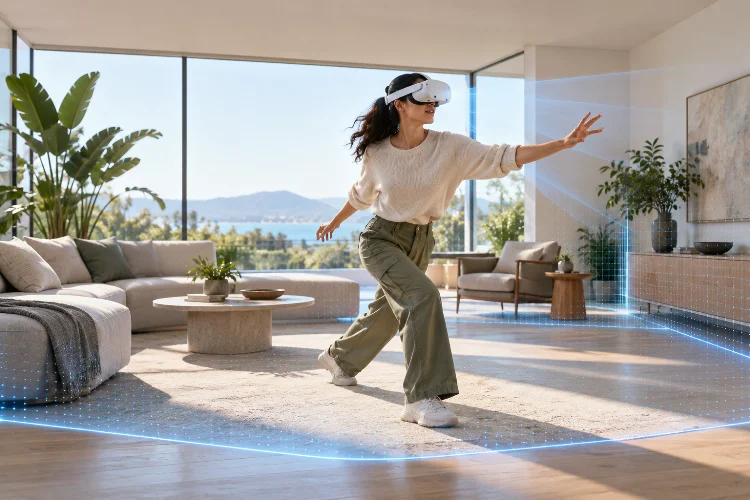
Virtual reality used to require more than simply putting on a headset. Early high-end setups often depended on external tracking hardware placed around the room, carefully positioned so the system could understand where the headset and controllers were moving.
Modern standalone VR has changed that experience dramatically.
How inside-out tracking shapes modern virtual reality games comes down to one major shift: much of the tracking hardware now travels with the headset itself.
Cameras and inertial sensors observe movement and the surrounding environment, allowing players to walk, crouch, turn, aim, and interact without installing external tracking stations.
Meta describes its current inside-out tracking systems as combining embedded cameras with sensors including accelerometers, gyroscopes, and magnetometers to estimate position and orientation in three-dimensional space.
That technological change affects far more than convenience. It influences room-scale game design, controller interactions, hand tracking, mixed reality, body tracking, portability, and even the types of movements developers can reasonably expect from players.
Inside-out tracking has effectively become part of the design language of modern VR.
1. Inside-Out Tracking Moves the Sensors Onto the Headset
The basic concept is surprisingly easy to understand.
With outside-in tracking, external equipment observes the headset or controllers from the room. With inside-out tracking, cameras and sensors attached to the headset observe the environment and estimate how the headset is moving relative to it.
Meta defines inside-out tracking as using embedded sensors and cameras in the head-mounted display to capture the environment and user movement without requiring external tracking sensors.
This creates a major usability advantage.
A player can take a standalone headset into another room, establish a playable area, and begin using VR without permanently mounting tracking equipment.
That portability helped make room-scale VR far more accessible.
Instead of designing primarily for enthusiasts with dedicated VR spaces, developers can create games for people playing in bedrooms, living rooms, offices, or relatively small open areas.
2. Sensor Fusion Keeps Movement Stable
Cameras are only one part of the tracking system.
Modern headsets also contain inertial measurement sensors capable of detecting acceleration and rotation.
These different information sources complement each other.
Cameras can observe features in the physical environment and help determine where the headset is located. Inertial sensors react rapidly to changes in motion and orientation.
The system combines these signals to create a continuously updated estimate of the headset’s pose.
This process is one reason inside-out tracking can remain responsive even during rapid head movements.
Meta’s current documentation lists accelerometers, gyroscopes, magnetometers, and onboard cameras among the technologies involved in its tracking architecture.
For games, stable tracking is essential.
When a player leans 20 centimeters to the left, the virtual camera needs to move accordingly. If physical and virtual motion disagree, immersion breaks almost immediately.
3. Modern Tracking Can Be Surprisingly Precise
Convenience would not matter much if inside-out tracking were fundamentally inaccurate.
Modern systems, however, can achieve impressive precision under appropriate conditions.
A 2026 robot-controlled evaluation of Meta Quest 3 measured a three-dimensional translational RMSE of approximately 0.621 mm and mean rotational RMSE of 0.143 degrees under controlled laboratory conditions.
The researchers stressed that their experiment used stable conditions, a single headset, and carefully repeatable trajectories, so the results should not automatically be generalized to every real gaming environment.
That limitation is important.
Players move unpredictably.
Rooms have different lighting.
Controllers may disappear behind a player’s body.
Fast movements can challenge tracking differently from controlled laboratory trajectories.
Still, results like these demonstrate how far headset-based tracking has progressed.
Inside-out systems are no longer simply a convenient alternative. They can provide enough precision for demanding interactive applications.
4. Controller Tracking Combines Cameras and Inertial Sensors
Tracking the headset is only part of the problem.
VR games also need to know where the player’s hands are.
Meta’s camera-tracked controllers combine an internal IMU with infrared LEDs that headset cameras can detect.
Computer vision estimates the controller’s pose from those observations, while machine-learning systems can help estimate its position when LEDs are temporarily hidden.
This makes controllers behave like virtual objects with six degrees of freedom.
Move your hand forward and the virtual controller moves forward.
Rotate your wrist and a virtual sword or pistol rotates with it.
For developers, this creates an enormous range of possibilities.
Traditional buttons can coexist with physical gestures. Players can manually reload weapons, throw objects, swing tools, point toward interfaces, climb surfaces, or physically block attacks.
The player’s actual movement becomes part of the game mechanic.
5. Occlusion Is Still One of the Biggest Challenges
Inside-out tracking has a natural limitation: headset cameras cannot directly see through the player’s body.
Imagine reaching behind your back to grab a virtual weapon.
Or holding one controller close to your face while the other sits behind it.
The cameras may temporarily lose a clear view.
Meta notes that camera-tracked controllers have a tracking volume defined by the headset cameras. IMUs can continue estimating movement for a short period when controllers move outside that field of view, but the estimate becomes less accurate as time passes.
Lighting can create additional problems.
Meta also warns that very bright illumination or direct sunlight can interfere with infrared LED tracking on some controller generations.
These limitations influence game design.
Developers need to avoid assuming that every hand position can always be tracked with identical accurracy.
A competitive archery game, for example, should be tested carefully when players bring one hand near their face. A melee game needs to consider what happens when players swing behind their body.
Tracking limitations become design constraints.
6. Machine Learning Helps Fill Tracking Gaps
Modern VR systems increasingly compensate for missing observations rather than immediately giving up when cameras lose sight of a controller.
Meta says its controller systems use machine-learning models alongside traditional computer vision to estimate pose when infrared LEDs become occluded or lighting becomes difficult.
The same idea is expanding to broader body movement.
Meta’s Wide Motion Mode uses Inside-Out Body Tracking to provide plausible hand positions even when hands move outside the headset cameras’ normal field of view.
However, Meta explicitly notes that these estimated poses are less accurate when direct hand tracking has been lost.
That distinction matters.
Estimated motion can be excellent for social presence or broad gestures.
It may not be appropriate for interactions requiring millimeter-level precision.
Future VR games will increasingly need to understand not simply where a tracked body part appears to be, but also how confident the runtime is in that estimaton.
7. Inside-Out Tracking Enabled Easier Room-Scale Gaming
One of the largest gameplay changes created by inside-out tracking is practical room-scale movement.
Players can physically walk within a defined play area without external sensors surrounding them.
Meta’s current design documentation supports both stationary and room-scale setups, with room-scale environments allowing users to define physical boundaries around their available space.
This changes locomotion design.
Developers can combine virtual joystick movement with actual physical repositioning.
A player might walk around a table physically while using artificial locomotion to cross a larger virtual building.
Games can also encourage crouching, leaning, dodging, reaching, and taking cover.
Physical movement becomes another input channel.
That makes VR fundamentally different from traditional gaming, where movement is usually translated through buttons or analog sticks.
8. Hand Tracking Pushes VR Beyond Controllers
Inside-out cameras can increasingly track the player’s hands directly.
OpenXR provides standardized hand-tracking structures that can expose the position and orientation of individual hand joints when supported by the runtime and hardware.
This allows games to build interactions around actual fingers rather than requiring a physical controller.
Players can pinch objects, point at interfaces, press virtual buttons, or use natural gestures.
The absence of controllers can make certain experiences feel more intuitive.
But hand tracking introduces its own problems.
Hands contain many joints and frequently occlude themselves. Fingers overlap. One hand may block another. Fast motions are difficult to observe perfectly.
That means controller-based input will likely remain valuable for precision-heavy gaming.
The future is probably multimodal rather than controller-free: games choosing between tracked hands, physical controllers, gaze, voice, and other inputs depending on the interaction.
9. Inside-Out Body Tracking Expands Game Design Again
Head and hand tracking are no longer the end of the story.
Modern headsets are beginning to estimate more of the player’s body.
Meta introduced Inside-Out Body Tracking for Quest 3 to map upper-body movement using headset-based computer vision. The company specifically highlighted potential improvements for fitness, combat, and social-presence applications.
This could significantly change future games.
A boxing game can better estimate shoulder and arm movement.
A fitness title can recognize broader exercise patterns.
Social VR avatars can represent upper-body posture more naturally.
Locomotion systems can use arm movement as meaningful input.
The more accurately the headset understands the player’s body, the less developers need to fake movement through canned animation.
However, estimated tracking should still be distinguished from directly observed movement.
For precision-critical mechanics, developers need to know which pose information is tracked confidently and which is being inferred.
10. Inside-Out Tracking Makes VR More Portable
Perhaps the largest impact of inside-out tracking is not a technical specification.
It is friction.
External tracking systems can be extremely capable, but they require installation, configuration, power, and a dedicated physical setup.
Inside-out tracking moves much of that complexity into the headset.
Players can carry the device somewhere else and establish a new tracking space relatively quickly.
That changes the potential audience for VR.
It also changes development assumptions.
Game designers can no longer assume that every player has a large permanent VR room. Experiences need to work across different play spaces and tracking conditions.
Modern VR design therefore increasingly emphasizes flexible boundaries, seated and standing alternatives, recentering systems, variable movement options, and interactions that tolerate differences between rooms.
Tracking architecture has quietly influenced game design at almost every level.
11. Tracking Spaces Must Stay Consistent
A VR application needs a coordinate system that connects the real and virtual worlds.
OpenXR defines reference spaces such as VIEW, LOCAL, and STAGE. The specification notes that runtimes using inside-out tracking can make small adjustments to tracked coordinate spaces as their understanding of the environment improves over time.
Developers need to account for this behavior.
Virtual objects attached to the user’s hand, floor, or environment should respond appropriately when tracking information updates.
OpenXR’s xrLocateSpace interface allows applications to request the position of one tracked space relative to another at a specified time.
These systems sound abstract, but they support something players immediately understand:
A virtual table should stay where the game says it is.
A sword should remain attached to the hand.
The floor should feel stable.
Good tracking infrastructure makes those relationships feel natural.
Inside-out tracking has reshaped modern virtual reality by moving much of the tracking infrastructure directly into the headset.
Cameras, inertial sensors, computer vision, machine learning, and standardized tracking APIs now allow players to move through room-scale environments, use 6DoF controllers, interact with their hands, and increasingly represent broader body movement without surrounding themselves with external hardware.
The technology still has limitations. Occlusion, lighting, tracking volume, fast movement, and inferred poses can affect consistancy, which means developers must design around real-world conditions rather than ideal laboratory setups.
When trying a modern VR game, pay attention to how naturally the system handles leaning, crouching, reaching, aiming, and moving outside the headset’s direct view.
When inside-out tracking works well, you barely notice it – and that may be its biggest achievement.

