
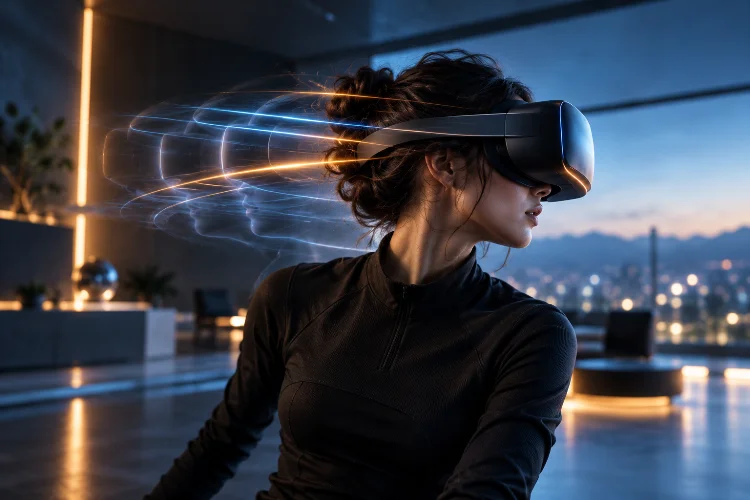
Move your head inside a VR headset and the virtual world seems to respond instantly. Of course, nothing in a computer system is truly instant.
Your movement first needs to be detected by tracking sensors.
The headset estimates your new pose, the game updates its simulation, the CPU prepares rendering work, the GPU creates an image, the VR runtime processes that image, and finally the display sends photons toward your eyes.
The delay across that complete chain is commonly called motion-to-photon latency.
Understanding motion-to-photon latency in modern VR gaming is important because virtual reality connects physical movement directly with visual feedback.
Even small timing errors can make a virtual environment feel less stable, reduce interaction accuracy, or contribute to discomfort.
A research study measuring several consumer VR systems found mean latency of roughly 21-42 milliseconds at the beginning of sudden controller movement. Once prediction became effective, functional latency fell to approximately 2–13 milliseconds.
That difference shows why modern VR relies on much more than simply rendering frames quickly.
1. What Motion-to-Photon Latency Actually Measures
Motion-to-photon latency describes the time between a tracked physical movement and the corresponding visual change reaching the display.
Imagine turning your head to the right.
The headset’s sensors first detect acceleration and rotation. Software estimates the new head orientation, the game engine determines what the virtual camera should see, and the GPU renders an updated image.
That frame then passes to the VR compositor before reaching the headset display.
The total delay across these stages is the motion-to-photon time.
Research reviews describe it as a form of end-to-end latency and note that excessive delay can reduce performance and contribute to cybersickness.
This also explains why measuring only GPU rendering time is not enough.
A frame could take just 5 milliseconds to render while the complete physical-to-visual pipeline takes considerably longer.
2. Tracking Latency Starts the Entire Pipeline
The latency chain begins before the game engine renders anything.
The headset first needs to determine where the player is.
Modern VR hardware commonly combines cameras with inertial sensors such as accelerometers and gyroscopes. Inertial sensors can respond extremely quickly, while visual tracking helps correct accumulated positional errors.
This sensor fusion produces an estimated head pose.
However, the pose being measured represents where the player’s head was a tiny moment ago.
By the time the resulting frame appears, the player’s head may already have moved again.
That creates one of VR’s fundamental engineering problems: rendering from the latest measured position can still produce an image based on outdated information.
The solution is predicton.
Instead of asking only, “Where is the headset now?” modern VR systems also estimate, “Where will the headset probably be when this frame becomes visible?”
3. OpenXR Uses Predicted Display Timing
Modern XR platforms coordinate rendering around the expected moment a frame will appear.
OpenXR provides a good example.
Its xrWaitFrame function returns a predicted display time for the next frame. Applications can then use that target when calculating the head and eye views used for rendering.
The system becomes even more interesting with xrLocateViews.
OpenXR notes that pose predictions can become more accurate when requested closer to the intended display time. This allows applications to obtain updated view information relatively late in the rendering pipeline, reducing prediction error.
In simple terms, a VR engine does not want to render where your head was.
It wants to render where your head is expected to be when the image reaches your eyes.
The shorter and more predictable the pipeline becomes, the easier this prediction is.
4. Frame Rate Determines the Available Timing Budget
Refresh rate creates a strict schedule for VR rendering.
At 72 Hz, a display refresh happens roughly every 13.9 milliseconds.
At 90 Hz, the interval is about 11.1 milliseconds.
At 120 Hz, it falls to approximately 8.3 milliseconds.
The game must complete its necessary CPU and GPU work quickly enough to deliver frames on schedule.
Epic Games notes that frame-rate consistency is particularly important in VR and recommends leaving performance headroom because occasional long frames can cause discomfort.
Unreal’s documentation also explains that VR avoids deeply pipelining multiple frames because doing so would introduce additional input and tracking latency.
This makes optimization different from conventional gaming.
A flat-screen game might tolerate an occasional frame-time spike.
Inside VR, that spike can make the entire virtual world temporarily feel disconnected from head motion.
For immersive gaming, consistancy is often more valuable than achieving an impressive maximum FPS.
5. The Compositor Reduces Perceived Latency
One of the most important technologies in modern VR sits between the game and the display: the compositor.
Meta describes its compositor as the system responsible for operations between an application’s submitted frame and the final image shown on the headset. One of its major jobs is reducing perceived latency through reprojection or time warp.
Suppose a game finishes rendering an image.
A few milliseconds later, just before display, the headset receives a newer head-orientation estimate.
Instead of throwing away the completed image and rendering everything again, the compositor can transform the existing frame so it better matches the latest head pose.
This is commonly known as time warp.
Meta explains that TimeWarp samples a newer HMD pose closer to the final compositing stage, helping keep the image visually stable relative to the tracked world.
The underlying frame may be slightly old.
The compositor effectively updates its perspective at the last possible moment.
6. SpaceWarp Can Create Frames When the Game Cannot
Modern VR systems can go even further by synthesizing intermediate frames.
Meta’s Application SpaceWarp allows an application to render at half the headset’s output rate while the compositor generates additional frames using motion vectors and depth information.
For example, an application might render at 36 FPS while the system produces a 72 FPS display output. Meta says its initial testing found App SpaceWarp could provide up to 70% additional compute budget, depending on the application.
This gives developers more time for simulation, graphics, and complex environments.
However, synthesized frames are not free.
Fast-moving objects, transparent surfaces, incorrect motion vectors, and rapidly changing scenes can create artifacts. Meta also notes that controller input latency can be higher in reduced-rate Space Warp scenarios.
So frame generation can improve smoothness without making the original application simulation equally fast.
That distinction matters in fast VR games.
7. Sudden Movement Is Harder to Predict
Prediction works best when movement follows a reasonably stable pattern.
If you are rotating your head at a steady speed, software can estimate where it will probably be several milliseconds later.
Suddenly reverse direction and prediction becomes much harder.
Research measuring HTC Vive, Oculus Rift, Rift S, and Valve Index systems found that sudden movement onset produced average latencies of approximately 21-42 milliseconds.
After predictive systems adapted to ongoing motion, effective latency fell substantially to around 2–13 milliseconds.
The researchers also found that sudden acceleration, impacts, and direction changes could increase latency and reduce spatial accuracy.
This explains why VR latency cannot always be summarized with one fixed number.
A headset might feel extremely responsive during smooth movement but briefly experience greater error when motion changes unexpectedly.
The timing behavior of the system matters just as much as its average latency.
8. Why Low Latency Matters for Comfort
VR latency is not only a competitive performance problem.
It can affect comfort.
Your vestibular system senses physical head movement while your eyes observe movement inside the headset. When the visual response does not match physical motion closely enough, the disagreement can become uncomfortable.
A review of VR latency research concluded that high motion-to-photon latency can contribute to cybersickness and that both latency magnitude and latency spikes deserve attention.
It cites recommendations of less than roughly 20 milliseconds for highly responsive VR, while also emphasizing that tolerable thresholds are not universal.
Another experimental study deliberately added display delay and found that increasing differences between physical and virtual head orientation were associated with greater cybersickness and reduced perceived scene stability.
That is why stable latency matters.
A consistently responsive system is usually preferable to one that alternates unpredictably between very low and much higher delays.
9. Competitive VR Makes Latency Even More Important
In slower VR experiences, a few extra milliseconds may be difficult to notice.
Competitive games are different.
Imagine aiming a virtual pistol while quickly turning your wrist.
Or blocking a fast sword attack.
Or returning a table-tennis ball whose trajectory depends on the exact position and orientation of the controller.
In each case, tracking, simulation, rendering, pose prediction, and display timing influence what the player sees.
Higher motion-to-photon delay can mean the displayed weapon position slightly trails the real controller.
Prediction compensates for much of this, but unexpected movement still creates opportunities for error.
Competitive VR developers therefore need to profile the entire pipeline rather than concentrating only on raw graphics performance.
The objective is not simply beautiful rendering.
It is low-latency responiveness that remains stable when players move quickly.
10. Developers Optimize the Whole Pipeline
Reducing VR latency is rarely achieved with one setting.
Developers need to consider tracking quality, CPU simulation time, rendering cost, GPU load, compositor timing, refresh rate, pose prediction, and display presentation together.
OpenXR helps synchronize applications with predicted display timing. Compositors apply late-stage pose corrections.
Reprojection can compensate when a frame becomes slightly outdated. Space Warp can provide additional compute headroom when applications cannot sustain the headset’s full native rate.
Profiling is therefore essential.
A graphics-heavy scene might cause GPU latency.
Complicated gameplay systems may create CPU delays.
A missed refresh deadline can suddenly add an entire display interval.
The best VR systems minimize all of these problems while keeping enough performance headroom for unusually demanding moments.
When everything works properly, players notice almost none of this technology.
The virtual world simply stays where it is supposed to be.
Motion-to-photon latency is one of the most important hidden technologies behind convincing VR gaming.
It covers the complete journey from physical movement through tracking, pose prediction, simulation, rendering, compositing, reprojection, and finally the headset display.
Modern systems use predicted display timing, time warp, sensor fusion, and frame synthesis to keep that journey as short and stable as possible.
Low latency improves more than technical performance. It makes aiming feel tighter, head movement feel natural, and virtual environments feel physically anchored.
When evaluating a VR game or headset, do not look only at resolution and refresh rate. Pay attention to how immediately the world follows fast head and controller movements.
When motion-to-photon latency is handled well, technology disappears – and immersion takes its place.

