
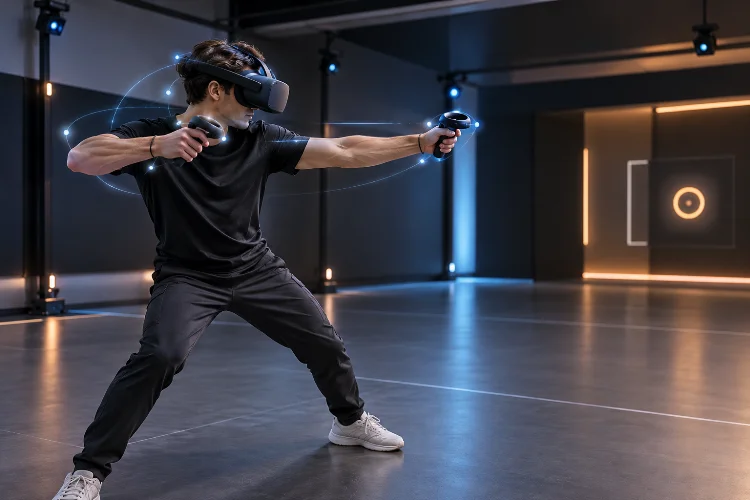
In a traditional competitive game, aiming usually depends on a mouse, controller stick, or touchscreen. In virtual reality, your actual head, hands, arms, and sometimes your entire body become part of the input system.
That makes tracking accuracy incredibly important.
Understanding how VR tracking systems influence competitive game accuracy means looking at what happens between a physical movement and its virtual representation.
Every swing, shot, block, throw, or dodge depends on sensors estimating exactly where a device is located and how it is oriented.
Modern VR systems can combine cameras, inertial measurement units, infrared markers, computer vision, and predictive algorithms to produce six-degrees-of-freedom tracking.
Meta, for example, describes its headset tracking as using embedded cameras alongside accelerometers, gyroscopes, and other sensors to estimate movement in three-dimensional space.
For casual experiences, small tracking errors might barely matter. In a competitive match, a few millimeters, a moment of tracking loss, or delayed pose information can change the result of an interaction.
1. Competitive VR Depends on Accurate 6DoF Tracking
Most modern VR controllers use six degrees of freedom, usually shortened to 6DoF.
Three dimensions describe position: left and right, up and down, and forward and backward. The other three represent rotation through pitch, yaw, and roll.
Together, these measurements allow a controller to behave like a physical object inside a virtual world.
If you rotate your wrist while aiming a virtual pistol, the game needs to reproduce that rotation accurately. If you move the controller ten centimeters forward, the virtual hand should follow approximately the same path.
Meta’s current controller technology documentation describes its 6DoF systems as combining inertial sensors with camera-based tracking.
Camera-tracked controllers can use infrared LEDs, while newer self-tracked controllers may include their own onboard tracking sensors.
Competitive precision depends on how consistently those measurements remain aligned with the player’s real movement.
2. Inside-Out Tracking Trades External Hardware for Flexibility
Standalone VR headsets commonly use inside-out tracking.
Instead of placing tracking stations around the room, cameras mounted on the headset observe the environment and estimate the headset’s movement relative to surrounding features.
Meta’s current tracking architecture uses embedded cameras together with inertial sensors for this purpose.
The advantage is convenience.
Players can enter VR without permanently installing external hardware around the play area. This has helped make room-scale VR dramatically easier to use.
Modern inside-out systems can also be highly accurate under suitable conditions.
A 2026 laboratory evaluation of Meta Quest 3 headset tracking reported mean translational RMSE of 0.346 mm across individual axes and a 3D RMSE of 0.621 mm under controlled robot-driven testing.
The researchers also reported mean rotational RMSE of 0.143°.
However, laboratory accuracy does not automatically mean identical performance in every gaming environment.
Lighting, motion speed, occlusion, and environmental features can still affect real-world tracking.
3. Base-Station Tracking Can Offer Strong Occlusion Robustness
Another approach uses external reference hardware.
SteamVR Tracking systems, commonly associated with Lighthouse base stations, track compatible devices relative to externally generated signals.
This approach can be especially useful when multiple tracking points need strong coverage across a defined play space.
A study evaluating SteamVR Tracking 2.0 found submillimeter and subdegree errors in static testing, with similarly strong dynamic results under its experimental conditions.
The researchers also found that accuracy declined somewhat as movement speed increased.
Interestingly, four-base-station configurations generally provided greater tracking accuracy and robustness than two-station setups, particularly during dynamic tests and situations involving occlusion.
That matters in competitive VR because fast movements can put controllers behind the player’s body or outside an ideal sensor view.
A system with more tracking coverage has more opportunities to maintain an accurate pose.
4. Occlusion Can Directly Affect Aim and Interaction
Tracking systems cannot always see everything.
Imagine pulling a virtual bow. One controller may briefly sit behind the other.
Or imagine aiming a rifle while bringing one controller close to your face.
With camera-based tracking, part of the controller may become hidden from the headset’s cameras.
This is occlusion.
Modern platforms try to compensate using inertial information and predictive models. Meta states that its controller tracking can use machine-learning models to estimate controller poses when LEDs are hidden or lighting conditions become difficult.
Its Wide Motion Mode can even provide estimated hand positions when hands move outside the normal field of view, although Meta notes that these estimated poses become less accurate when direct tracking is lost.
This distinction matters for competitive games.
An approximate pose may be perfectly acceptable for waving at another player.
It may be much less acceptable when determining whether a virtual sword actually blocked an attack.
Developers therefore need to understand where occlussion normally occurs during competitive actions and design interactions around those limitations.
5. Sensor Fusion Makes Tracking Faster and More Stable
Camera tracking can provide detailed positional information, but cameras alone are not ideal for every rapid movement.
That is why VR devices combine multiple sensors.
Inertial measurement units can include accelerometers and gyroscopes that update movement information very quickly. Visual tracking can then help correct accumulated errors and maintain the device’s position relative to the physical environment.
This combination is known broadly as sensor fusion.
The advantage is complementary information.
IMUs respond rapidly to sudden motion but can accumulate drift over time. Cameras provide environmental references that help correct that drift but may struggle with occlusion or poor visual conditions.
Combining both systems produces a more useful estimate than depending entirely on either one.
This is particularly valuable for fast competitive movements such as flick aiming, punching, swinging, or quickly changing direction.
The player does not care which sensor produced the information.
They care that the virtual controller follows their real hand predictably.
6. Pose Prediction Helps Compensate for Tracking Latency
Even perfect sensor measurements would still arrive too late if a VR system simply rendered the last known position.
Tracking, game simulation, rendering, and display all require time.
By the moment an image reaches the player’s eyes, their hand or head may already have moved.
Modern VR runtimes therefore predict poses into the near future.
Meta’s controller API documentation explains that controller poses can be predicted in synchronization with headset rendering to support low-latency presentation.
OpenXR provides similar timing concepts. Its xrLocateSpace interface allows applications to request an object’s pose for a specified time, including a future moment. For future timestamps, the runtime uses its latest prediction of where that tracked space will be.
OpenXR also provides predicted display timing so applications can request view poses for approximately when the rendered frame will actually appear.
Prediction improves responsivness, but it creates another trade-off.
Predicting too far ahead increases the possibility that sudden changes in motion will make the prediction wrong.
7. Tracking Accuracy Can Change During Fast Movement
A tracker that performs perfectly while sitting still may behave differently when swung rapidly.
This is important because competitive VR is full of high-speed movement.
An earlier HTC Vive study found high tracking precision and a measured end-to-end latency of approximately 22 milliseconds under its testing conditions.
Later SteamVR Tracking 2.0 research also found that accuracy could decrease as movement velocity increased, even though overall dynamic results remained strong in the experimental setup.
This illustrates why static accuracy specifications do not tell the whole story.
A competitive tracking system needs to remain accurate during the exact movements players actually perform.
For a shooting game, that might include rapid controller rotation.
For table tennis, it may involve extremely fast paddle swings.
For melee combat, both translational velocity and angular velocity can become significant.
Tracking should therefore be evaluated dynamically, not only by measuring a controller sitting motionless on a table.
8. Calibration Errors Can Become Competitive Errors
Tracking hardware can be extremely precise while still producing an inaccurate gameplay result if calibration is wrong.
Suppose a player’s real controller and virtual weapon are offset by a small angle.
Every movement might be tracked consistently, but the weapon could still point slightly away from where the player expects.
Over time, players might compensate through muscle memory.
Change the calibration and that learned correction suddenly becomes wrong.
Research on Lighthouse-based tracking has shown that tracking systems can achieve very high precision while still exhibiting systematic positional effects depending on setup and geometry.
One HTC Vive Pro investigation reported highly repeatable measurements while also observing systematic deviations that could reach several centimeters in particular configurations.
That highlights the difference between precision and accuracy.
A system can repeatedly produce nearly identical measurements without those measurements being perfectly aligned with the true physical position.
Competitive VR therefore benefits from reliable calibraton, consistent coordinate spaces, and careful alignment between physical controllers and virtual objects.
9. Tracking Jitter Can Affect Fine Aim
Large tracking failures are easy to notice.
Small ones can be more frustrating.
Jitter occurs when a virtual controller makes tiny unwanted movements even though the player’s real hand is relatively stable.
Meta explicitly identifies jitter as small, high-frequency undesirable movement that may appear in tracked virtual hands.
For broad movements, tiny errors may be irrelevant.
For precision aiming, they can become noticeable.
Developers may apply smoothing filters to reduce visible jitter, but excessive smoothing creates additional lag.
Once again, there is a trade-off.
Aggressive filtering produces stable movement but can make controls feel heavy.
Minimal filtering preserves immediate movement but may expose more sensor noise.
Competitive systems need a carefully balanced solution that preserves quick motion while stabilizing small unwanted fluctuations.
10. Good Tracking Lets Skill Decide the Outcome
The ultimate purpose of competitive tracking technology is not technological perfection.
It is competitive trust.
A player should miss because their aim was wrong, not because the controller temporarily lost tracking.
A table-tennis shot should fail because the paddle angle was incorrect, not because pose estimation changed unexpectedly.
A sword block should work because the player’s movement reached the right location at the right time.
Modern VR systems are already capable of impressive tracking performance, but different technologies have different strengths.
Inside-out systems prioritize accessibility and portability, while externally referenced systems can provide excellent coverage and occlusion resistance in carefully configured spaces.
Prediction, sensor fusion, calibration, and filtering then help transform raw tracking information into usable game input.
The closer those systems get to the player’s true physical motion, the easier it becomes for genuine skill to determine the result.
VR tracking systems have a direct influence on competitive game accuracy because the player’s physical movement is part of the control system.
Accurate 6DoF tracking improves aiming, blocking, throwing, swinging, and movement, while sensor fusion and pose prediction help maintain stable responses with minimal perceived delay.
Occlusion, jitter, calibration errors, and high-speed movement can still introduce inaccuracies, which is why tracking quality must be evaluated under realistic gameplay conditions.
If you play competitive VR, pay attention to more than headset resolution or refresh rate. Test tracking during the actual motions your game demands and check for dead zones, occlusion, unexpected drift, or inconsistent alignment.
In competitive VR, reliable tracking is what turns physical practice into repeatable digital skill.

