
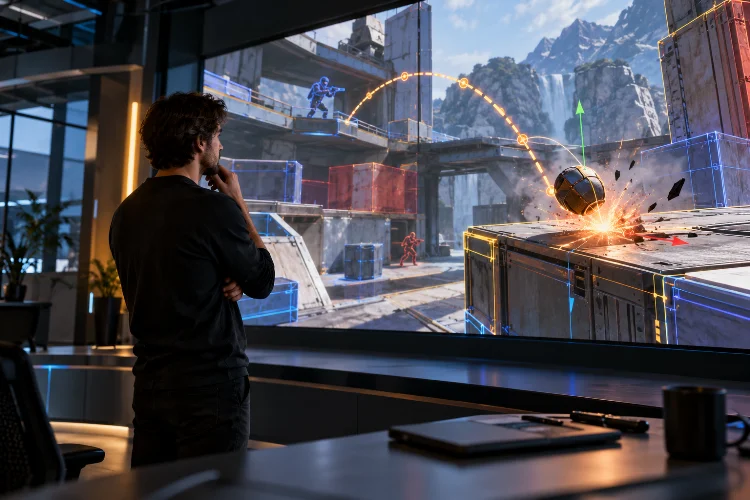
A rocket flies across the map, a player jumps onto a moving platform, two vehicles collide, and a grenade bounces around a corner.
To players, these events happen naturally. Behind the scenes, a physics engine is calculating movement, velocity, collisions, forces, friction, and dozens of other relationships.
In competitive multiplayer games, those calculations become especially important.
Understanding how physics engines affect competitive multiplayer mechanics means looking at more than realistic movement.
Physics systems influence hit detection, projectiles, character movement, vehicles, environmental interactions, and even whether two players agree about what just happened.
The difficult part is that multiplayer physics runs across machines connected by networks that introduce latency. Unreal Engine’s networked physics documentation notes that collisions become harder to synchronize as object velocity and network latency increase.
That creates a fundamental challenge for developers: physics needs to feel immediate on the player’s machine while remaining consistent with the authoritative game state on the server.
1. Physics Engines Create Rules for Movement and Interaction
A physics engine provides mathematical rules for how objects behave.
Rigid bodies can have mass, velocity, friction, gravity, and angular motion. Colliders determine where objects can touch, while constraints control relationships between objects.
Competitive games often simplify real-world physics deliberately.
A tactical shooter does not need perfectly realistic human movement. It needs movement that is predictable, readable, and responsive.
The same is true for jumping, sliding, recoil interactions, grenades, and vehicles.
This distinction is important because competitive mechanics depend on consistency more than realism.
If identical actions produce noticeably different results under similar conditions, players struggle to build reliable mechanical habits.
Physics design therefore asks a practical question: not “Is this perfectly realistic?” but “Can players understand and master this behavior?”
2. Fixed Timesteps Keep Physics More Predictable
Physics simulation usually operates differently from visual rendering.
A game may render at 144 FPS or 240 FPS, while physics runs at a fixed update frequency.
Unity, for example, uses a fixed timestep for physics. Its current documentation lists 0.02 seconds as the default, equivalent to 50 physics updates per second. Reducing the timestep increases simulation frequency and can improve accuracy, but it also raises CPU usage.
Why use a fixed timestep?
Imagine physics being calculated only whenever a visual frame appears.
A powerful computer producing 240 FPS and a slower machine producing 60 FPS could potentially calculate movement differently if physics depended completely on rendering speed.
Fixed updates help separate simulation timing from graphics performance.
That improves consistancy, which is critical when competitive mechanics depend on jump trajectories, object movement, or collision timing.
The trade-off is computational cost.
Higher physics frequencies provide more simulation steps, but every additional step requires CPU time.
3. Collision Detection Can Decide Whether an Interaction Counts
Collision detection answers one of the most basic questions in a game:
Did these objects touch?
For slow objects, this can be relatively straightforward.
Fast-moving objects are more complicated.
Suppose a small projectile travels so far between two physics updates that it begins on one side of a wall and ends on the other. A basic discrete collision system may never observe it intersecting the wall.
This problem is commonly called tunneling.
Continuous Collision Detection, or CCD, tries to solve it by predicting collisions between physics steps.
Unity’s documentation explains that continuous modes can prevent fast-moving rigid bodies from passing through objects, although these modes have greater performance costs than standard discrete collision detection.
Unreal’s Chaos documentation similarly describes CCD as a way to prevent missed collisions for fast-moving particles, while noting the added performance cost.
For competitive games, developers must decide which objects actually need that accuracy.
Using expensive collision calculations for every decorative object would waste resources.
4. Projectiles Can Be Simulated or Simplified
Not every weapon needs to use the same physical model.
Some competitive shooters use hitscan-style weapons, where the engine evaluates a ray or trace immediately rather than simulating a physical bullet traveling through space.
Other weapons use projectiles with measurable velocity.
Those projectiles may experience gravity, collision, bouncing, or drag depending on the design.
The choice changes gameplay dramatically.
A hitscan weapon rewards accurate targeting at the moment of firing. A slower projectile also requires prediction because players must estimate where the opponent will be when the projectile arrives.
Grenades add another layer.
Their competitive value may depend on predictable bouncing, friction, velocity, and surface interaction.
If grenade physics behaves differently because of unstable simulation timing, players cannot reliably learn lineups.
In esports-oriented design, predictable simluation frequently matters more than maximum physical complexity.
5. Network Physics Creates Multiple Versions of Reality
Single-player physics is difficult enough.
Multiplayer adds a much bigger problem: every machine may temporarily disagree.
Unreal Engine describes multiplayer around an authoritative server that owns the true game state, while clients maintain local approximations using replicated information.
Now imagine a player pushing a physics object.
Their client wants the interaction to happen immediately.
But the server may not receive that input for tens of milliseconds.
If the game waits for confirmation, the interaction feels slow.
If the client simulates everything independently, its result may disagree with the server.
Modern engines therefore use techniques such as prediction, correction, interpolation, and resimulation to hide these differences.
The goal is not making network delay disappear.
It is making that delay less visible while preserving an authoritative result.
6. Prediction Makes Physics Feel Immediate
Client prediction allows a player’s machine to estimate the result of an action before server confirmation arrives.
For example, when a player applies force to an object, the local client can immediately display the expected movement.
Later, the server sends its authoritative version.
If the prediction was correct, everything continues smoothly.
If not, the client must correct itself.
Unreal Engine’s Predictive Interpolation mode allows local clients to apply predicted physical forces before receiving the final server result. Epic notes that higher latency and faster-moving objects can reduce the quality of this replication.
This illustrates an important multiplayer principle.
Prediction improves responsivness, but prediction is not truth.
The authoritative server still needs a mechanism for resolving disagreements.
Too many obvious corrections can make objects appear to snap, jitter, or move unnaturally.
7. Resimulation Can Correct Prediction Errors
More advanced systems can go beyond simple corrections.
Unreal Engine’s Resimulation mode stores a history of previous physics states on the client.
When authoritative server information arrives, the client compares that state with its cached history. If the difference is large enough, the engine can rewind to the earlier state, apply the correction, and simulate forward again to the present.
This approach can make complex physics-driven characters and objects more accurate in multiplayer.
But it is not free.
Maintaining physics history requires memory and CPU resources. Replaying simulation steps adds additional work.
The engine may also need to visually smooth the corrected object afterward so players do not see an abrupt jump.
This explains why competitive multiplayer physics often uses different approaches for different objects.
A player-controlled physics pawn might justify expensive resimulation.
A loose can on the floor probably does not.
8. Interpolation Makes Remote Objects Look Smooth
Prediction works well for actions generated by the local player because the client already knows its own inputs.
Remote players are different.
Your computer does not know what another player is about to press.
Trying to predict their future movement too aggressively would produce frequent errors.
Instead, multiplayer games commonly interpolate between received network states.
Valve’s Source networking documentation explains how clients use interpolation along with prediction and server-side lag compensation to deal with network delays.
Interpolation intentionally displays remote movement using known states rather than guessing completely unknown future input.
This can produce smoother motion.
The trade-off is a small amount of visual delay.
Developers therefore tune interpolaton carefully. Too little may produce jitter, while too much makes remote players appear farther behind the server’s current state.
9. Lag Compensation Changes Competitive Hit Detection
Competitive shooters introduce one particularly controversial problem.
You might shoot at an enemy exactly where they appear on your screen, but by the time that input reaches the server, the enemy has already moved.
Without compensation, the server could reject what looked like an obvious hit.
Source-style lag compensation addresses this by storing recent player positions.
Valve’s documentation describes a system where the server estimates when a command was created, temporarily rewinds other players to their earlier positions, evaluates the shot, and then restores the current game state.
This can improve fairness for players with ordinary network latency.
But compensation also creates trade-offs.
A player with very low latency may occasionally feel as though they were hit after already moving behind cover because the shooter’s older view was considered.
There is no perfect solution.
Competitive networking is often about choosing which imperfections feel fairest.
10. Physics Performance Can Affect Frame Rate
Physics accuracy competes with performance.
More collision checks, more rigid bodies, smaller timesteps, complex constraints, and continuous collision detection all require processing power.
Unity explicitly warns that smaller fixed timesteps create more frequent and stable physics updates but consume additional CPU resources.
If physics falls behind, the engine may need multiple updates in a single visual frame, creating what its documentation describes as an escalating performance problem or “spiral of doom.”
This is especially important in multiplayer games containing many physical objects.
Developers may simplify distant objects, disable unnecessary simulation, use simpler colliders, or reserve expensive physics for gameplay-critical elements.
Competitive games need performance headroom.
An extremely realistic destruction system is not particularly useful if activating it causes frame times to spike during the exact firefight where players need maximum responsiveness.
11. Competitive Physics Is Really About Trust
Players rarely praise a physics engine when it works perfectly.
They simply trust the game.
They expect the same jump to travel the same distance.
They expect projectiles to follow familiar trajectories.
They expect collisions to occur where objects appear to be.
They expect shots and movement to behave predictably despite network latency.
That trust is incredibly important.
Competitive mechanics depend on players building precise expectations through repetition.
If physics regularly produces unexpected corrections, missed collisions, unstable movement, or inconsistent interactions, players begin fighting the engine instead of their opponents.
The best physics technology is therefore often invisible.
It gives players enough realism to understand the world, enough consistency to master it, and enough network correction to keep everyone reasonably synchronized.
Physics engines influence competitive multiplayer mechanics far beyond making objects bounce or fall realistically.
They control collision detection, movement, projectiles, fixed simulation timing, prediction, interpolation, and interactions between players across a network.
Systems such as CCD, client prediction, lag compensation, and physics resimulation exist because multiplayer games must balance responsiveness with an authoritative shared reality.
For developers, the key is choosing where precision actually matters.
Not every object needs expensive simulation, but mechanics that affect movement, combat, or competitive outcomes need to behave predictably.
When evaluating a multiplayer game, look beyond visual realism. Pay attention to whether movement feels stable, collisions make sense, projectiles behave consistently, and online interactions match what players see.
Those details reveal how well the physics engine is supporting the competition underneath.

