
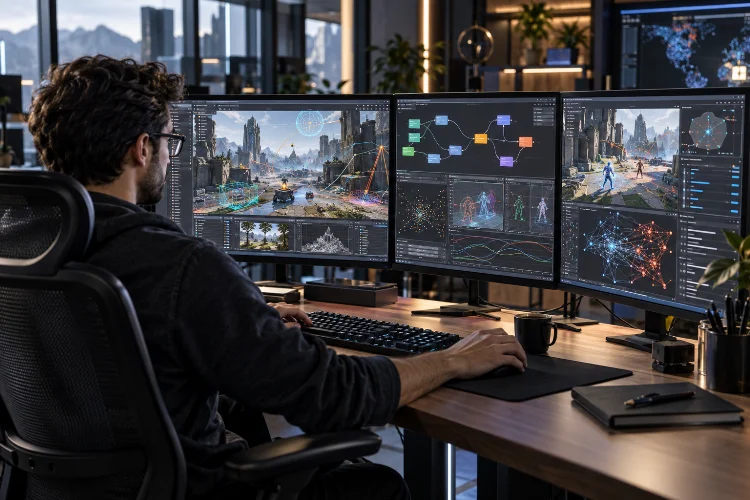
When a competitive player clicks the mouse, dodges an attack, or throws an ability, the action may look almost instantaneous. Behind that simple moment, however, a game engine is performing an enormous amount of work.
It processes input, updates game logic, calculates physics, communicates with servers, renders the next frame, synchronizes other players, and tries to complete everything quickly enough that the experience still feels immediate.
That is why advanced game engine technology behind modern competitive games matters so much.
For casual games, a small delay or inconsistent frame may be annoying. In esports, it can change how a duel feels, influence hit registration, or affect whether players trust what they see on screen.
Modern engines therefore prioritize much more than impressive graphics.
Technologies such as server-authoritative networking, client prediction, sub-tick input processing, multithreading, fixed-step simulation, low-latency rendering, and anti-cheat infrastructure all contribute to competitive integrity.
Understanding these systems gives us a much clearer picture of what actually happens between pressing a button and seeing the result.
1. Competitive Engines Must Prioritize Responsiveness
A modern game engine has many responsibilities.
It handles rendering, animation, audio, artificial intelligence, physics, scripting, networking, asset streaming, and player input. Competitive games add another requirement: all of those systems need to operate with extremely predictable timing.
A beautiful frame is less useful if it arrives too late.
This is why competitive titles often prioritize high and stable frame rates over the most expensive visual effects available.
Frame consistency is particularly important. A game running at an average of 200 frames per second can still feel bad if individual frames suddenly take much longer to complete.
Game engines therefore include profiling and scheduling systems that help developers find CPU or GPU bottlenecks.
Unreal Engine, for example, exposes task systems that can distribute gameplay code across worker threads and organize dependent jobs asynchronously.
Epic recommends avoiding unnecessary waits because blocking work can reduce scalability and introduce performance problems.
The goal is simple: complete important work before the next frame needs to appear.
2. Server-Authoritative Networking Creates a Shared Reality
Online competitive games face an unusual problem.
Every player is experiencing the match on a different machine, connected through a network with different latency, packet loss, and connection quality.
Someone needs to decide what actually happened.
Most serious online competitive systems therefore use some form of server authority.
In Unreal Engine’s client-server networking model, the server maintains the authoritative game state while clients send actions and receive replicated information about movement, variables, and gameplay events.
That architecture helps prevent every player’s local machine from becoming equally trusted.
For example, your client may display your movement immediately, but the server ultimately determines whether the movement, hit, or ability interaction is valid.
The difficulty is making this authority feel responsive.
Waiting for every action to travel to the server and back before showing anything would make the game feel painfully delayed.
That is why competitive engines use additional techniques.
3. Prediction and Interpolation Hide Network Latency
Suppose your network round-trip latency is 60 milliseconds.
If a game waited for the server before displaying every movement, your character could feel disconnected from your controls.
Client-side prediction helps solve this problem.
The local game estimates what should happen immediately after your input. When the authoritative server response arrives, the client compares the predicted state with the real one and corrects differences when necessary.
Unity’s multiplayer documentation describes a related client-anticipation model that allows local visual values to respond before authoritative server confirmation arrives, then smooth or correct the result later.
Remote players create another challenge.
Their position updates do not arrive every rendered frame. Engines commonly interpolate between received states so movement looks smooth rather than jumping between network updates.
Prediction and interpolation improve responsivness, but they also create difficult design trade-offs.
Too much prediction can produce noticeable corrections. Too much smoothing can make remote movement feel delayed.
Competitive engines constantly balance immediacy against accuracy.
4. Tick Rate Is Only Part of the Timing Story
Competitive players often discuss server tick rate.
A tick is essentially one update step in which a server processes part of the game state.
Historically, higher tick rates could allow servers to evaluate gameplay at shorter intervals, although this also increases CPU and network requirements.
Modern engine design can go beyond relying purely on traditional fixed tick intervals.
Counter-Strike 2 is a major example.
Valve describes its Source 2 networking as using a sub-tick architecture where servers can know the precise moment that movement begins, a shot is fired, or a grenade is thrown rather than relying only on discrete tick boundaries.
This illustrates an important trend.
Competitive engine technology increasingly focuses on when an input occurred, not simply which server update happened to contain it.
That can make interactions more precise without assuming that tick rate alone determines the entire networking experience.
5. Physics Needs Predictable Simulation Timing
Physics engines are another hidden part of competitive gameplay.
Projectiles, collisions, player movement, vehicles, environmental objects, and abilities may all interact with simulation systems.
Physics calculations need stable timing.
Unity, for example, uses a fixed timestep for its physics loop. Its current documentation explains that smaller timesteps create more frequent and potentially more accurate simulation updates, but they also increase CPU cost.
This creates a classic engine trade-off.
Run physics more frequently and the simluation can become more precise.
Run it too frequently and CPU workload may become excessive.
Networked physics adds even more complexity because two machines may simulate the same interaction with slightly different timing.
Unreal Engine’s networked physics documentation notes that latency makes collision-based synchronization increasingly difficult, particularly when objects move quickly.
Competitive game developers therefore need clear rules about which physics interactions are authoritative and which can be approximated locally.
6. Multithreading Helps Engines Reach High Frame Rates
Modern processors contain many CPU cores.
A game engine that performs everything sequentially on one core can leave enormous computing capacity unused.
Multithreading allows engines to execute certain workloads simultaneously.
One thread might prepare rendering commands while other worker threads process animation, gameplay tasks, asset streaming, or supporting calculations.
Unreal Engine’s current Tasks System uses worker threads and dependent task graphs to execute gameplay code asynchronously. Its TaskGraph infrastructure is designed to operate across multiple threads on supported platforms.
The challenge is synchronization.
Some tasks depend on the results of others. Running everything simultaneously can create race conditions where calculations happen in the wrong order.
Developers therefore divide work into tasks with clearly defined dependencies.
Good multithreading improves performance without changing gameplay results.
Poor multithreading can create stutters, bugs, or inconsistent behaviour.
For competitive games, timing consistancy is usually more important than simply maximizing total theoretical CPU usage.
7. Rendering Technology Is Also a Latency Problem
Rendering is often discussed in terms of image quality.
Competitive players care about something else too: how quickly the rendered image reflects their latest input.
This is commonly described as system latency or click-to-photon latency.
The full chain can involve the input device, CPU simulation, render submission, graphics driver, GPU workload, display scanout, and monitor response.
NVIDIA Reflex, for example, is designed specifically to reduce latency in this pipeline. Its low-latency mode synchronizes CPU and GPU work closer to just-in-time rendering rather than allowing unnecessary render queues to build up.
Modern engines can also expose latency markers that help developers measure individual stages of this process.
This matters because high FPS and low latency are related but not identical.
A game can produce many frames while still allowing a long render queue.
Competitive engine optimization therefore looks not only at how many frames are generated but also how old the player input is when each frame reaches the display.
8. Engine Networking Must Control Bandwidth Carefully
Competitive servers cannot simply send every piece of information to every player continuously.
That would consume enormous bandwidth.
Instead, engines prioritize relevant information.
Unreal Engine’s networking architecture includes systems for replication relevancy, priority, filtering, and dormancy.
These mechanisms help developers control which objects need updates for specific clients and how urgently those updates should be transmitted.
Imagine a large multiplayer map.
A player may need frequent updates about an enemy directly around the corner but far less information about an inactive object hundreds of meters away.
Smart replication reduces unnecessary traffic.
This also helps servers scale.
The less irrelevant information being processed and transmitted, the more computing resources remain available for gameplay events that actually matter.
Competitive networking is therefore partly about deciding what not to send.
9. Anti-Cheat Technology Is Becoming an Engine-Level Concern
Competitive integrity is not only about low latency and accurate physics.
The engine must also operate in an environment where some players may attempt to manipulate the client.
This has made anti-cheat increasingly connected to engine and online-service architecture.
Epic Online Services, for example, provides Easy Anti-Cheat interfaces that can launch protected clients and allow servers to validate whether players are operating through the expected anti-cheat environment.
Server authority also supports this goal.
If a client could freely decide its own position, damage, ammunition, or movement speed, cheating would become much easier.
Competitive games therefore avoid trusting client information whenever important gameplay results can be validated elsewhere.
Anti-cheat is still a continuous technical contest.
No system eliminates cheating permanently.
The engine’s job is to reduce trust, validate important actions, detect abnormal behaviour, and make manipulation progressively harder.
10. The Future Is About Reducing the Distance Between Input and Outcome
Game engines are becoming increasingly sophisticated, but competitive development still revolves around a surprisingly simple question:
How quickly and accurately can the game turn player intent into a trustworthy result?
Sub-tick input processing attempts to capture actions more precisely.
Prediction hides network delay.
Multithreading helps finish CPU workloads faster.
Fixed simulation steps improve stability.
Low-latency rendering reduces the delay between simulation and display.
Server authority and anti-cheat systems protect competitive integrity.
Each system addresses a different part of the same pipeline.
The ideal competitive engine almost disappears.
Players stop thinking about networking, physics, rendering, or replication because every action simply feels immediate and predictable.
That invisible reliability may be one of the most impressive technical achievements in modern competitive gaming.
Advanced game engine technology is one of the main reasons modern competitive games can support fast mechanics, global online play, complex environments, and precise interactions at the same time.
Behind every movement or shot is a chain involving input processing, simulation, networking, physics, CPU scheduling, rendering, and security.
Technologies such as server authority, prediction, sub-tick processing, fixed timesteps, multithreading, and low-latency rendering help keep that chain fast and reliable.
For players, most of this technology remains invisible – and that is exactly the point.
The next time a competitive game feels exceptionally smooth, pay attention to more than its graphics.
Stable frame timing, reliable hit registration, responsive controls, and predictable movement reveal just as much about the quality of the engine underneath.

