
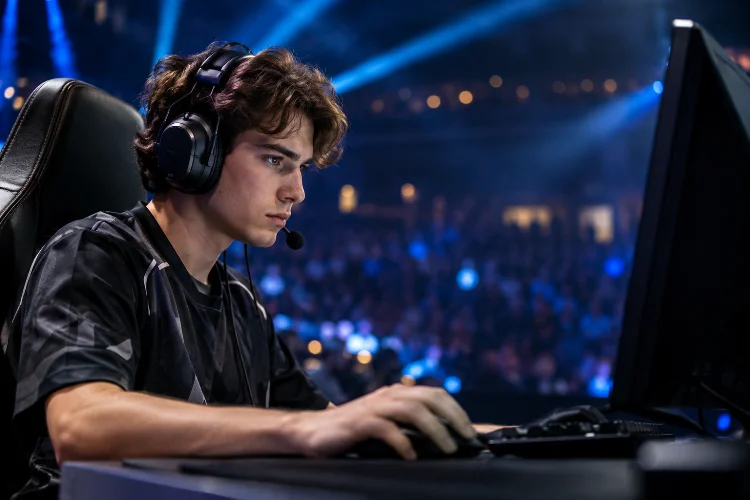
Professional players make difficult shots, inputs, and decisions look almost effortless.
What makes those moments impressive is not simply mechanical skill – it is the ability to reproduce that skill when the score is tied, thousands of people are watching, and one mistake could decide the match.
Pressure changes the environment. Hands can become tense, attention can narrow, decision-making may speed up or slow down, and players can suddenly start thinking about movements that normally happen automatically.
Understanding how professional players maintain accuracy under pressure therefore requires looking beyond aim training alone.
High-level accuracy depends on mechanical consistency, visual attention, anticipation, emotional regulation, preparation, physical condition, and thousands of hours spent recognizing familiar situations.
Research using professional Counter-Strike data has even found measurable performance declines during particularly high-pressure overtime situations, showing that elite players are not immune to competitive stress.
The difference is that experienced competitors develop systems that make accurate execution more reliable when pressure rises.
1. Professional Accuracy Starts Before the Shot
Accuracy is often treated as a purely mechanical skill.
In reality, positioning and anticipation frequently determine how difficult the mechanical action becomes.
Consider two FPS players facing the same opponent. One is holding the correct angle with their crosshair already positioned near the expected target. The other must notice the enemy, move the crosshair across the screen, adjust vertically, and then shoot.
The second player needs considerably more correction.
Elite competitors try to create the first situation as often as possible.
This principle extends beyond shooters. Fighting-game professionals position themselves around expected attack ranges, while MOBA players anticipate movement and ability timing before committing skill shots.
Professional accuracy therefore begins with reducing unnecessary mechanical difficulty.
Good positioning makes precise execution easier.
2. Attention Control Keeps Important Information Clear
Competitive games constantly compete for a player’s attention.
There may be enemies, teammates, maps, abilities, timers, animations, health information, sound cues, and objectives appearing simultaneously.
Professional players learn to filter this information efficiently.
Research comparing professional and non-professional FIFA esports players found that professionals displayed more focused visual-search behavior, including shorter initial fixation durations and greater attention toward important areas of the screen.
That matters because accurate execution begins with identifying the right target quickly.
An elite player does not necessarily process every visual element equally. They prioritize the information most likely to influence the next action.
Under preassure, this selective attention becomes especially valuable.
Instead of scanning everything, players narrow their focus toward the cues relevant to the current situation.
3. Mechanical Consistency Beats Highlight-Level Speed
Professional players obviously practice mechanics.
But their objective is not simply producing the fastest possible movement.
It is producing the correct movement repeatedly.
Tournament performance rewards consistancy far more than occasional spectacular execution.
A player who can land an extremely difficult shot three times out of ten may look impressive in a montage. A professional usually needs movements that remain reliable across dozens of rounds, maps, and matches.
That changes how practice should work.
Mechanical training can begin in controlled environments where players focus on precision. Speed is then added gradually. Eventually, the same movements should be tested in unpredictable situations where positioning and decision-making compete for attention.
The goal is to move accurate mechanics from conscious effort toward automatic execution.
Once a movement becomes familiar, players have more mental capacity available for strategy.
4. Elite Players Avoid Overthinking Automatic Skills
One strange effect of pressure is that players can start consciously controlling movements they normally perform automatically.
Instead of simply aiming, they begin thinking about how they are aiming.
Instead of executing a familiar combination, they mentally monitor every input.
This can interfere with smooth execution.
Research examining professional CS competition found performance declines during high-pressure overtime rounds, with the effect more pronounced in live environments than online matches.
The findings offer esports-specific evidence that competitive pressure can disrupt individual performance even among experienced players.
Professional routines help reduce this problem.
Rather than focusing internally on every hand movement, players often direct attention toward external goals: the opponent’s position, the next angle, the tactical objective, or the next piece of information.
The mechanics are allowed to operate in the background.
5. Short Reset Routines Prevent One Miss From Becoming Five
Even world-class players miss easy shots.
The important skill is preventing that miss from affecting the next one.
A player who immediately starts thinking, “How did I miss that?” has shifted attention away from the current match. Frustration can increase muscle tension and make future decisions more emotional.
Professional competitors therefore benefit from short reset routines.
A reset could involve one controlled breath, relaxing the shoulders or grip, adjusting posture, and using a short internal cue such as “next play.”
It does not need to be dramatic.
The purpose is simply to return attention to present information.
A systematic review of 19 esports studies identified performance pressure, defeat, team-related issues, organizational demands, and other stressors as common parts of competitive esports. It also documented various coping approaches used by players.
Accuracy becomes easier to maintain when previous mistakes stop following players into future situations.
6. Practice Should Reproduce Competitive Pressure
Perfect accuracy in an empty training environment is useful, but incomplete.
Matches contain uncertainty.
Players have opponents who move unpredictably, teammates communicating simultaneously, scores that matter, and only seconds to select the correct response.
Practice should eventually include those conditions.
A useful progression might move from isolated precision drills to reactive exercises, then game-specific scenarios, scrimmages, and finally tournament-style practice.
The player gradually learns to maintain execution while cognitive load increases.
This is different from endless repetiton.
The objective is not merely repeating a movement thousands of times. It is teaching that movement to survive increasingly realistic conditions.
A 2026 randomized controlled trial involving 184 competitive esports athletes found that a program combining aerobic exercise and cognitive self-regulation produced greater improvements in reaction-time and decision-making measures than standard esports training under the study’s controlled conditions.
Structured training can therefore target more than raw mechanics.
7. Physical Condition Can Support Precision
Professional gaming is cognitively demanding, but physical condition still matters.
Fine motor control happens inside a body that experiences fatigue, tension, poor posture, and prolonged sitting.
Recent research has increasingly examined whether physical exercise can support gaming-related abilities.
A 2026 systematic review of 12 experimental studies reported that acute exercise was associated with improvements in outcomes including reaction time, executive function, aiming accuracy, and elimination performance.
Longer-term interventions produced more mixed direct gaming results.
A separate 2026 meta-analysis of 10 randomized controlled trials involving 503 participants reported positive effects of exercise interventions on reaction time and operational accuracy, alongside benefits in executive function and memory.
This does not mean professional players need exhausting workouts before tournaments.
Regular movement, aerobic conditioning, resistance training, and mobility work can simply become another part of supporting stable performance.
8. Recovery Protects Accuracy Across Long Sessions
Accuracy does not stay perfectly stable forever.
A player may begin practice feeling sharp but gradually become slower or less precise after hours of intense concentration.
Sleep and recovery therefore matter.
A study tracking 27 Counter-Strike players over 56 days found that better-performing players tended to spend more time sleeping at the between-person level.
Because the research was observational, it cannot prove that additional sleep directly caused stronger gaming performance, but it highlights an important relationship worth considering.
Fatigue can also create subtle problems.
A player may still feel mechanically capable while attention begins drifting. They react slightly later, miss information, or take unnecessary engagements.
Professional performance management is partly about recognizing when additional practice stops producing useful work.
Sometimes accuracy improves more from recovery than from another hour of aim training.
9. Accuracy Comes From Better Decisions, Not Only Better Aim
Perhaps the biggest misconception about professional accuracy is that it belongs entirely to the hands.
The brain usually determines how difficult the hands’ job becomes.
Research comparing esports experts with amateurs found a small overall cognitive advantage among experts, with particularly notable differences in spatial cognition and attention.
Experienced players often recognize patterns earlier.
They know where opponents are likely to appear. They understand common timing windows. They position crosshairs or abilities before the target fully reveals itself.
This makes their accurracy look almost superhuman.
In reality, many successful actions are partially prepared before the visible moment begins.
That is why high-level players should review misses carefully.
Ask whether the mechanical execution actually failed – or whether poor positioning, attention, timing, or prediction created an unnecessarily difficult action.
Fixing the earlier problem can improve precision more than simply training faster hand movement.
Professional players maintain accuracy under pressure by making precision part of a complete performance system.
Reliable mechanics matter, but so do positioning, anticipation, visual attention, emotional control, physical conditioning, recovery, and the ability to reset quickly after mistakes.
Research in esports also shows that pressure can reduce professional performance, meaning elite competitors are managing pressure rather than magically becoming immune to it.
If you want to improve your own accuracy, stop reviewing every miss as a mechanical failure.
Watch several important mistakes from your recent matches and identify what happened before the input itself. Check your positioning, attention, preparation, tension, and decision timing.
The more accurately you diagnose the cause of a miss, the more useful your next training session becomes.

