
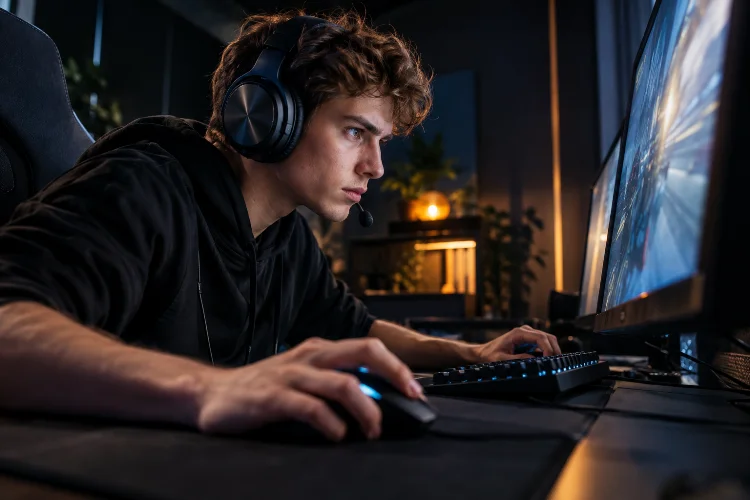
A fraction of a second can look incredibly small until you are holding an angle in a tactical shooter, trying to block an unexpected mix-up in a fighting game, or reacting to a sudden initiation during a late-game team fight.
At high competitive levels, those fractions matter.
However, how reaction time influences high-level competitive gaming is more complicated than simply asking who can click a button fastest.
Elite performance combines visual detection, attention, anticipation, decision-making, motor execution, and game knowledge. A player may have excellent raw reactions but still respond too late because they were watching the wrong part of the screen.
Research reflects this complexity. A 2024 meta-analysis covering 15 studies and 1,085 participants found that esports experts showed a small overall cognitive advantage over amateurs, especially in spatial cognition and attention.
Interestingly, reaction-time measures alone did not consistently explain the difference between groups.
So reaction speed matters, but what matters even more is how effectively players use it.
1. Reaction Time Is More Than Clicking Fast
Reaction time is usually described as the interval between detecting a stimulus and producing a response.
In gaming, the process contains several stages.
A player has to notice something, recognize what it means, choose an appropriate response, and physically execute that response. Every stage adds time.
Consider an FPS player spotting an opponent.
Seeing the opponent is only the first step. The player must recognize whether the target is hostile, determine whether to shoot, move the crosshair, and execute the input accurately.
That is why simple reaction-time tests only reveal part of competitive performance.
A professional player may not have dramatically faster raw reflexes than every experienced amateur, yet their game-specific reactions can appear much faster because they process relevant information more efficiently.
A 2023 study comparing professional Counter-Strike players with novices found significantly shorter simple reaction times among professionals.
EEG measurements also showed earlier neural responses, with differences in P300 latency averaging roughly 20-70 milliseconds.
2. Anticipation Can Beat Pure Reaction Speed
The fastest reaction is often the one that has already been prepared.
Professional players rarely treat every possible event as equally likely. They use positioning, opponent habits, sound cues, resources, previous actions, and game knowledge to predict what may happen next.
Imagine two tactical shooter players holding the same angle.
Player A is mentally prepared for three possible enemy positions. Player B is trying to monitor seven.
Even with identical biological reaction speed, Player A has less uncertainty to process when the opponent appears.
This is where anticipation becomes extremely important.
The 2024 meta-analysis of esports expertise found stronger differences in attention and spatial cognition than in reaction-time measurements alone. The researchers also highlighted anticipation and decision-making as important areas for future esports expertise research.
High-level players therefore do not just react quickly.
They create situations where the correct response becomes easier to recognize.
3. Visual Processing Determines What You React To
Reaction speed becomes useless if the player does not notice the relevant information.
Competitive games constantly flood the screen with visual stimuli: opponents, teammates, effects, minimaps, cooldowns, health bars, animations, objectives, and environmental movement.
Elite players become selective.
Research comparing professional and non-professional FIFA esports players found that professionals demonstrated more focused visual-search behavior, including shorter first-fixation durations and more efficient attention toward important areas of the display.
This suggests an important distinction.
Better players do not necessarily see everything faster. They become better at directing attention toward information that matters.
A recent 2026 study comparing regular League of Legends players with controls similarly found faster bilateral visual reaction times and quicker target selection among players, alongside stronger hand-eye coordination measures.
The authors recommended evaluating multiple psychomotor abilities rather than relying on a single reaction test.
That is much closer to what actually happens during competition.
4. Speed Must Be Balanced With Accuracy
There is little value in reacting 30 milliseconds faster if the response is wrong.
This creates the classic speed-accuracy trade-off.
A fighting-game player who attempts every defensive response instantly may become vulnerable to feints.
An FPS player who fires immediately at every movement can sacrifice precision. A MOBA player who reacts instantly to an apparent engagement may use a critical ability before understanding the full situation.
High-level players need controlled speed.
The objective is not simply reducing reaction time. It is reducing reaction time while maintaining decision quality.
This distinction also helps explain why cognitive research does not show one universal reaction-time advantage among esports experts.
The 2024 meta-analysis found a significant advantage for accuracy-related measurements, while the overall effect for reaction-time measures was not significant.
In other words, elite performance is not a race to respond first regardless of context.
Fast and correct beats fast and careless.
5. Hardware Latency Becomes Part of the Reaction Chain
Human reaction time is only one part of what players experience.
Competitive gaming also contains system latency.
Your input has to travel through a mouse, keyboard, controller, computer, game engine, display, network, and sometimes a remote server before an action is fully represented.
Each component may contribute a small delay.
At casual levels, minor differences may not always be noticeable. At elite levels, however, players often try to reduce unnecessary latency because competitive engagements can already be decided within very narrow timing windows.
This explains the popularity of high-refresh-rate monitors, high-performance peripherals, stable frame rates, and optimized competitive settings.
But hardware should be viewed as an amplifier rather than a replacement for skill.
Reducing technical latency cannot compensate for poor positioning, weak visual attention, or slow decision-making.
The player still needs to recognize the situation correctly.
6. Fatigue Can Quietly Slow Performance
Reaction speed is not perfectly stable throughout the day.
Mental fatigue, sleep loss, stress, and long competitive sessions can influence attention and response speed.
A controlled study involving Rocket League players examined approximately 29 hours of total sleep deprivation.
Sleep-deprived participants reported lower alertness and motivation and showed worse response speed on psychomotor vigilance and choice-response tasks, including roughly five times as many vigilance lapses.
Interestingly, overall Rocket League performance itself did not significantly decline in that specific experiment.
This is an important reminder that esports performance contains redundancy.
Experienced players may temporarily compensate for slower cognitive responses through game knowledge or familiar movement patterns.
But that does not mean fatige is harmless.
When players compete across multiple maps or long tournament days, even occasional attention lapses can matter.
Recovery therefore supports reaction performance indirectly by helping players remain attentive enough to recognize situations quickly.
7. Physical Exercise May Support Faster Responses
Professional esports training increasingly includes some physical activity, and research is beginning to explain why.
A 2026 systematic review and meta-analysis included 10 randomized controlled trials involving 503 participants. Physical activity interventions were associated with faster reaction time, improved operational accuracy, and benefits in executive function and memory.
Another 2026 randomized trial involving 184 competitive esports athletes compared standard esports practice with individualized psycho-physical training that combined aerobic exercise and cognitive self-regulation.
The intervention group showed stronger and more stable improvements in measures related to reaction time, attention, and decision-making. The researchers nevertheless noted that additional confirmatory trials are needed.
This does not mean players need exhausting workouts immediately before competition.
Regular aerobic training, movement, and structured physical conditioning may complement gaming practice by supporting the cognitive and physiological systems behind performance.
8. Reaction Training Should Look Like the Game
Clicking circles on a reaction-time website can measure simple reflexes.
It does not necessarily train everything required during competition.
Game-specific reaction practice should include uncertainty and decision-making.
An FPS player might practice distinguishing between several possible targets rather than shooting one predictable stimulus.
Fighting-game players can train reactions to different offensive options. MOBA competitors can use replay scenarios where they must recognize initiation cues and select an appropriate ability.
Progress From Simple to Complex
A useful progression is:
Detection → Choice → Execution → Game Scenario
First, improve basic recognition and mechanical execution.
Then introduce multiple possible responses.
Finally, reproduce realistic situations where positioning, timing, information, and opponent behavior influence the decision.
A 2026 scoping review of esports cognition concluded that cognitive differences appear to be domain-specific rather than evidence of one universal gaming advantage.
Attention, visual-attentional control, and speeded sensorimotor procesing showed relatively consistent associations with expertise, while other cognitive areas produced more mixed findings.
Training should reflect that complexity.
9. Measure Competitive Reaction, Not Only Test Scores
A reaction-time score can be interesting, but players should avoid obsessing over a single number.
Someone reducing a simple visual reaction test from 220 milliseconds to 205 milliseconds has improved that test.
Whether this improvement transfers to tournament performance is another question.
Instead, combine basic testing with game-specific metrics.
Look at first-shot speed and accuracy, successful defensive reactions, missed ability windows, target-selection errors, response consistency, and decision quality under pressure.
Video review is particularly useful.
Pause the match before a critical moment and ask whether the problem actually involved slow reation time.
Often, the player reacted slowly because their attention was misplaced, their positioning created too many threats, or they failed to anticipate the opponent.
Fixing those problems can create a much larger practical improvement than shaving several milliseconds from a laboratory-style test.
Reaction time matters in high-level competitive gaming, but elite performance cannot be reduced to raw reflex speed.
The strongest players combine fast responses with visual attention, anticipation, accuracy, game knowledge, reliable mechanics, and efficient decision-making.
Research comparing esports experts with less experienced players supports differences in several cognitive and psychomotor areas, but it also shows that expertise is broader than simply having faster reactions.
Players who want to improve should therefore train the entire reaction chain: notice useful information, interpret it correctly, choose the right response, and execute it consistently.
Review your next competitive session with that framework in mind. Instead of asking only, “Was I too slow?” ask, “Why did I need to react late in the first place?”
That question often reveals a much more valuable path toward better performance.

