
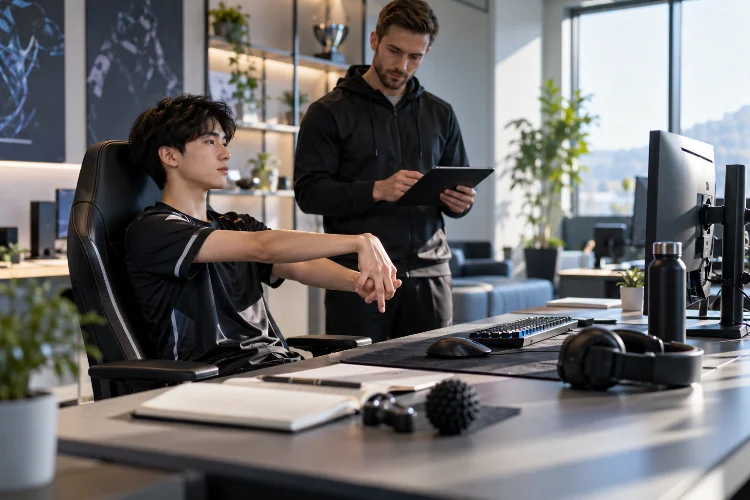
Professional eSports training is no longer just about playing ranked matches for ten hours and hoping thousands of repetitions eventually create an elite player.
At the highest level, nearly everyone already has impressive mechanics, extensive game knowledge, and years of experience.
The bigger challenge is turning those abilities into consistent tournament performance while avoiding mental fatigue, physical problems, and inefficient practice.
That is why advanced performance training for professional eSports players needs a broader approach.
Mechanical practice remains important, but modern performance systems can also include tactical analysis, cognitive training, physical conditioning, structured recovery, communication practice, and detailed performance reviews.
Research involving 1,835 esports players found considerable differences in training demands between titles such as Counter-Strike, League of Legends, Rocket League, FIFA, and StarCraft II.
It also showed that training accounted for roughly 39% of reported playing time on average.
The lesson is simple: there is no universal training program for every competitive game. Elite preparation needs to match the actual demands of the player, role, team, and title.
1. Separate Playing From Deliberate Training
Playing a game and training for a game are not automatically the same thing.
A professional player can complete eight hours of scrims and ranked matches without directly improving the weakness that limits their performance. More volume does not always create better results.
Structured practice begins with a specific objective.
An FPS player might spend one session improving first-shot accuracy or defensive positioning. A MOBA player could work specifically on wave management before major objectives.
A fighting-game competitor might repeatedly practice defensive responses against one difficult matchup.
Research on esports performance suggests that different games require distinct combinations of tactical knowledge, coordination, perception, motor ability, and game-specific skills.
Train the Weakest Relevant Skill
The key word is relevant.
A weakness should matter to actual competition. Improving an impressive-looking mechanic that rarely affects tournament results may be less valuable than fixing a simple positioning mistake that causes several deaths every series.
Elite training therefore becomes increasingly selective.
2. Train Mechanics for Consistency, Not Highlights
Professional players obviously need exceptional mechanical ability.
But tournament performance rewards consistancy more than occasional spectacular plays.
Mechanical practice should reproduce movements and decisions that occur regularly during competition.
Depending on the game, this could include aiming, tracking, movement, combos, camera control, ability sequences, last-hitting, defensive inputs, or rapid target selection.
The objective is to make important actions reliable enough that players can execute them while simultaneously thinking about strategy.
This is where repetition remains valuable.
However, endless repetiton without feedback can reinforce inefficient habits. Mechanical drills should include measurable targets such as accuracy, completion speed, error rate, consistency across sets, or execution under increasing difficulty.
Once a skill becomes stable in an isolated environment, it should be transferred into realistic gameplay.
3. Develop Cognitive Performance Alongside Mechanics
Competitive gaming is an intense cognitive activity.
Players continuously filter visual information, track multiple resources, predict opponents, remember previous actions, communicate, and choose between different options under time pressure.
Training should reflect those demands.
Rather than focusing exclusively on reaction speed, professional players can develop situational recognition, attention control, working memory, anticipation, and decision efficiency through game-specific scenarios.
For example, teams can pause VODs before important engagements and ask players to predict what happens next.
What does the opponent probably want?
Which resources remain available?
Where is the highest-risk position?
What is the strongest response?
This trains players to interpret information rather than simply react after something happens.
Physical exercise may also support some cognitive abilities relevant to esports.
A 2026 meta-analysis of randomized controlled trials found positive effects of exercise interventions across areas including processing speed, operational precision, executive function, and memory in esports players.
4. Add Physical Conditioning to the Training System
A professional gaming career may happen in front of a monitor, but the player is still a biological system.
Hours of sitting, repeated hand movements, fixed postures, and sustained mental concentration create physical demands.
A recent systematic review of 12 experimental studies found that acute physical exercise was associated with improvements in esports-related outcomes including reaction time, executive function, aiming accuracy, and elimination performance.
Long-term interventions produced more mixed direct gaming results, although some studies reported improvements in coordination and executive functions.
This does not mean professional players should replace scrims with marathon training.
Moderate aerobic exercise, resistance work, mobility training, and regular movement can complement gaming practice.
There is also an injury-prevention reason to care.
A 2026 systematic review covering 789 professional e-athletes reported substantial prevalence of musculoskeletal disorders, commonly affecting areas including the lower back, shoulders, neck, and wrists. Longer training duration and inadequate ergonomic setups were among the associated factors.
Physical training should therefore support both performance and career durability.
5. Treat Sleep as Part of Training
Recovery is not what happens after training.
Recovery is part of training.
Professional gamers depend heavily on concentration, executive function, emotional regulation, and rapid information processing. Yet competitive schedules, late-night scrims, streaming obligations, international tournaments, and irregular routines can make sleep difficult.
A multinational study of 17 professional FPS players found a median total sleep time of about 6.8 hours, with participants displaying considerably delayed sleep schedules.
Another study followed 27 Counter-Strike players over 56 days and found that better-performing players spent more time sleeping at the between-person level, although the observational design does not establish that longer sleep directly caused better performance.
Professional teams can approach sleep similarly to other performance variables: track patterns, maintain predictable schedules where possible, and avoid treating exhaustion as proof of dedication.
The hardest training session becomes less useful when the player never properly recovrs from it.
6. Train Mental Resilience Under Competitive Pressure
Practice environments rarely feel exactly like a tournament final.
The stakes are different.
Professional players deal with pressure to win, public criticism, mistakes, team conflict, organizational demands, and the uncertainty of competitive careers.
A systematic review synthesizing 19 esports studies identified performance pressure and defeat alongside team, social, organizational, and personal stressors as recurring challenges for competitors.
Mental training should therefore involve more than motivational speeches.
Players can develop short reset routines after mistakes, structured pre-match preparation, breathing techniques, attention cues, and post-match reflection processes.
Pressure should occasionally appear inside training too.
Teams might practice disadvantage scenarios, tournament-style series, limited preparation windows, or high-stakes scrimmages where specific performance goals must be met.
The purpose is not to make every practice stressful.
It is to make pressure familiar enough that players still follow good decision-making processes when emotions increase.
7. Improve Communication as a Trainable Skill
Communication is another area professional players should deliberately practice.
High-level teams do not simply talk more. They transmit useful information faster.
A 2025 Counter-Strike study analyzed 4,040 in-game statements and found that expert teams communicated more frequently and effectively than nonexpert teams.
Their communication contained more factual and action-oriented information and was distributed more evenly between team members.
Teams can improve this through communication-focused scrims.
Coaches might review whether calls were timely, concise, accurate, and actionable rather than evaluating only tactical outcomes.
One unnecessary sentence may sound harmless.
During a two-second engagement, however, additional verbal clutter competes with information about movement, opponents, abilities, and positioning.
Efficient communication reduces that cognitive friction.
8. Use Analytics to Build Individual Training Plans
Professional training becomes significantly more useful when performance is measured.
Teams can track mechanics, decision errors, positioning patterns, communication mistakes, objective control, resource usage, sleep, training load, and other game-specific metrics.
But statistics need interpretation.
High damage does not automatically mean strong performace. A support player, defensive anchor, initiator, or information-focused teammate may contribute value that basic scoreboard metrics fail to capture.
The better approach is to connect measurements to responsibilities.
If a player’s role involves creating favorable openings, coaches should examine how often those openings actually produce team advantages.
VOD reviews are especially valuable here.
Rather than reviewing every mistake equally, identify recurring patterns. If the same problem appears five times across several matches, it deserves a targeted training block.
This creates a simple performance loop:
Measure → Diagnose → Train → Test → Review
Professional development becomes much easier to manage when practice follows evidence rather than mood.
9. Periodize Training Instead of Grinding Forever
Elite players cannot operate at maximum intensity every day.
Training load should change according to the competitive calendar.
Early preparation periods may contain experimentation, heavy mechanical work, physical conditioning, and tactical development.
Closer to tournaments, teams can shift toward match-specific strategy, scrimmages, opponent preparation, and maintaining mechanical sharpness.
Recovery periods also matter.
Constant maximum-volume practice can create fatigue without providing equivalent improvement.
Research on esports stress highlights relationships between competitive demands, coping, well-being, and performance, reinforcing the need to view players as complete performers rather than endlessly available gaming machines.
Professional training should therefore answer two questions.
What does the player need to improve?
And how much training can they productively absorb right now?
The second question is often ignored.
Advanced performance training in professional esports is becoming much more than simply accumulating hours inside a game.
Elite players need reliable mechanics, fast decision-making, tactical understanding, physical conditioning, efficient communication, psychological resilience, structured recovery, and meaningful performance analysis.
The best training systems connect these elements rather than treating each one separately. More practice is not automatically better practice.
Start by auditing one week of your current routine. Identify how much time is spent playing, deliberately developing weaknesses, reviewing performance, exercising, and recovering.
Then change one area instead of rebuilding everything overnight.
For serious competitive players, the long-term goal is not to train harder every day. It is to create a system that repeatedly produces better decisions, more consistent execution, and stronger performance when the matches actually matter.

