
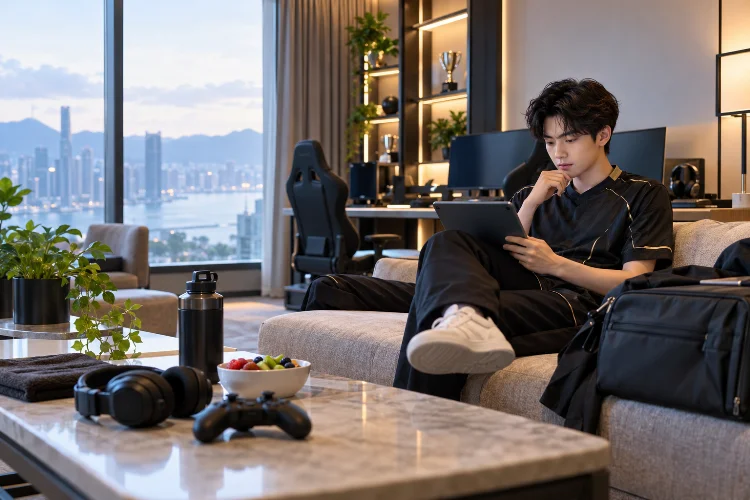
A brilliant tournament weekend can make a player look unstoppable. Maintaining that level for six months is a completely different challenge.
Professional eSports seasons can involve daily scrims, individual practice, league matches, international travel, constant game updates, media obligations, and repeated high-pressure competition.
Players are expected to maintain mechanical precision and fast decision-making even when motivation and energy naturally fluctuate.
That is why building consistent performance across long eSports seasons is less about reaching maximum intensity every day and more about managing performance intelligently.
A player who trains at 100% until exhaustion may briefly improve faster than someone following a structured schedule. Over an entire season, however, fatigue, physical discomfort, poor sleep, frustration, and burnout can eventually erase that advantage.
Modern performance management therefore needs to balance improvement with sustainability. Players must know when to train harder, when to maintain their level, when to recover, and how to recognize early signs that performance is beginning to decline.
The objective is not perfection every day. It is remaining competitively reliable when important matches arrive.
1. Stop Treating Every Week Like a Tournament Final
One of the fastest ways to create inconsistent performance is training at maximum intensity all season.
Competitive players need difficult sessions, but intensity should change according to the calendar.
A useful idea borrowed from traditional sport is periodization. Instead of maintaining identical workloads throughout the year, training is adjusted according to upcoming competitions, recovery needs, skill priorities, and accumulated fatigue.
Research on esports periodization is still developing.
A 2024 scoping review found that esports research contains useful knowledge on training, analytics, and performance metrics, but there is still no well-established, unified periodization model specifically for competitive gaming.
That limitation does not make workload planning useless.
A team might use higher-volume periods for experimentation and skill development, then gradually move toward match-specific scrims and lower-volume maintenance as an important tournament approaches.
After an intense event, the next priority may be recovry rather than immediately returning to twelve-hour practice days.
Long seasons reward players who can control intensity instead of constantly chasing maximum volume.
2. Monitor Training Quality, Not Just Training Hours
Professional gaming culture has often celebrated extremely long practice schedules.
But hours alone tell you very little about training quality.
Eight hours of unfocused ranked play may contribute less improvement than three highly structured hours targeting positioning, communication, mechanical weaknesses, and strategic decision-making.
The same principle applies during a long season.
When players become mentally tired, they may continue practicing while making increasingly poor decisions. That can create the illusion of discipline while actually reinforcing bad habits.
Track Performance Trends
Teams should monitor useful indicators across several weeks rather than reacting emotionally to one bad day.
Relevant measures could include mechanical accuracy, communication mistakes, decision errors, objective control, response consistency, scrim quality, sleep patterns, mood, and physical discomfort.
The goal is not creating hundreds of statistics.
It is identifying when normal variation becomes a repeated pattern.
If a normally reliable player experiences declining accuracy, poorer decision-making, reduced motivation, and increasing fatigue for several weeks, simply adding more practice may not solve the underlying problem.
3. Make Recovery Part of the Performance System
Recovery should not be viewed as time stolen from improvement.
It allows improvement to continue.
Professional esports creates several forms of load simultaneously. Players experience cognitive demands from constant information processing, psychological pressure from results and expectations, and physical stress from remaining in similar positions for long periods.
Research on professional e-athletes reinforces the physical side of this issue. A 2026 systematic review covering 789 players found substantial rates of musculoskeletal complaints, with frequently affected areas including the lower back, shoulders, neck, and wrists.
Longer training durations and inadequate ergonomic setups were associated with symptoms.
Recovery therefore needs several layers.
Players may benefit from genuine time away from the game, movement between sessions, physical conditioning, ergonomic adjustments, and scheduled lower-intensity days.
A rest day also does not need to mean doing absolutely nothing.
Light physical activity, social time, hobbies, and activities unrelated to competition can help create psychological separation from the game.
The key is returning to training more capable of producing quality work.
4. Protect Sleep Before Fatigue Becomes Normal
Sleep problems can gradually become invisible during a long season because players adapt psychologically to feeling tired.
That does not mean performance is unaffected.
A multinational study involving professional FPS competitors found delayed sleep schedules among participants, with median sleep duration around 6.8 hours. Researchers noted that sleep and mood management deserve greater attention in professional esports environments.
Another study evaluated a brief sleep intervention involving 56 esports athletes from South Korea, the United States, and Australia, highlighting the potential value of structured sleep education and behavioral support in esports settings.
Players do not need a perfectly identical bedtime every night, especially when tournaments involve international travel and late matches.
They do need to avoid making chronic sleep restriction part of normal training culture.
Maintaining a reasonably stable routine, managing caffeine timing, reducing unnecessary late-night practice, and planning around travel can support long-term readiness.
A player cannot control every tournament schedule.
They can control much of the preperation surrounding it.
5. Manage Burnout Before Motivation Collapses
Burnout rarely arrives suddenly.
It usually develops gradually.
Players may begin feeling physically exhausted, frustrated with practice, detached from competition, or convinced that their effort is producing little progress.
Research involving 453 competitive esports players identified meaningful relationships between burnout, resilience, and coping.
Problem-focused coping was associated with resilience factors, while avoidance-oriented coping showed positive associations with burnout symptoms.
Another 2024 study of professional League of Legends players in South Korea identified five broad areas connected with burnout experiences: performance, overtraining, interpersonal relationships, physical and psychological exhaustion, and career or motivational factors.
A separate analysis of 453 esports players classified participants into low-, medium-, and high-burnout-risk profiles, with the high-risk group representing 38.3% of the sample. Higher resilience and mental toughness were associated with lower-risk profiles.
These findings do not mean every tired player is experiencing clinical burnout.
They do suggest teams should take repeated exhaustion, declining motivation, and negative attitudes toward competition seriously.
Sometimes the solution is not another motivational speech.
It is fixing the workload or environment producing the problem.
6. Keep Physical Conditioning Inside the Season
Physical exercise does not need to disappear once tournament schedules become busy.
It may actually become more useful.
A 2026 systematic review of 12 experimental studies found that acute physical exercise was associated with improvements in several esports-related outcomes, including reaction time, executive function, aiming accuracy, and elimination performance.
Chronic interventions produced more mixed direct gaming results but showed benefits in areas such as coordination and executive function.
This suggests players do not need extreme fitness programs.
Consistency matters more.
Walking, aerobic exercise, resistance training, mobility work, and regular movement can support overall physical capacity while reducing the sedentary nature of professional gaming.
During busy competitive weeks, training volume can be adjusted rather than removed completely.
A short session that maintains movement and conditioning is often easier to sustain than repeatedly switching between extreme training and doing nothing.
For long seasons, sustainable habits usually beat heroic short-term routines.
7. Build Systems for Handling Competitive Stress
Mechanical performance is only one challenge across a long season.
Players also experience losses, roster tension, public criticism, contract uncertainty, tournament pressure, travel, coaching changes, and expectations from fans or organizations.
A systematic review synthesizing 19 esports studies identified recurring performance stressors such as defeat and pressure to win, alongside team, social, organizational, and personal sources of stress.
These pressures accumulate.
One disappointing match may be easy to manage. Ten disappointing matches combined with poor sleep and constant criticism can affect training behavior very differently.
Teams need processes for dealing with problems before every frustration becomes personal conflict.
That may include structured debriefs, clearer communication with coaches, defined times for tactical criticism, psychological support where available, and simple reset routines after matches.
Players also need an identity outside their latest result.
When every win becomes proof of personal worth and every loss feels like personal failure, emotional stability becomes much harder to maintain across an entire season.
Resilience does not mean ignoring disappointment.
It means returning attention to productive actions once the disappointment has been processed.
8. Review the Season in Blocks, Not Match by Match
Reacting dramatically to every individual result creates unstable training.
One bad series produces a new strategy.
Another loss produces new settings.
Three difficult scrims suddenly convince the team that everything needs rebuilding.
High-level organizations benefit from reviewing larger blocks of performace.
For example, evaluate the previous three or four weeks and look for repeated patterns.
Did communication decline?
Are late-game decisions becoming weaker?
Has mechanical consistency changed?
Is one player showing signs of accumulated fatigue?
Are the same tactical mistakes appearing against multiple opponents?
These questions produce much better information than simply looking at wins and losses.
A team can play well and lose.
It can also play badly and win.
Long-term improvement requires separating the quality of the process from short-term competitive variance.
That creates a useful seasonal cycle:
Train → Compete → Review → Recover → Adjust → Repeat
The objective is continuous refinement rather than constant reinvention.
Building reliable performance across a long eSports season requires more than mechanical talent and enormous practice volume.
Players need structured workloads, high-quality training, consistent sleep, physical conditioning, psychological recovery, stress-management systems, and performance reviews that look beyond individual match results.
Current esports research also suggests that burnout, physical discomfort, sleep issues, and competitive stress deserve serious attention rather than being accepted as unavoidable parts of professional gaming.
Start by reviewing the last month of your own competitive routine.
Look at training volume, sleep, physical activity, motivation, mechanical consistency, and recovery – not just your win rate.
Then identify one area that has become harder to maintain.
Improve that system before adding more training hours. Across a long season, the player who can repeatedly return to a strong baseline often becomes more valuable than the player who occasionally reaches an unsustainable peak.

