
Reaching an elite rank is difficult. Staying there while continuing to improve is an entirely different challenge.
At higher levels of competitive gaming, basic advice such as “practice more” stops being enough. Most elite players already understand the mechanics, maps, characters, matchups, and common strategies of their chosen game.
The difference between strong and exceptional performance increasingly comes from how efficiently those skills are developed.
That is why advanced skill development for elite competitive gaming should focus on targeted improvement rather than simply accumulating more hours.
Research involving 1,835 esports players found that competitive performance involves multiple areas, including sensorimotor control, strategic-cognitive abilities, psychological factors, physical competencies, and social skills.
The researchers also found substantial differences between the training demands of different esports titles.
The practical lesson is straightforward: elite players need training systems built around their actual competitive weaknesses, not generic routines copied from somebody else.
1. Separate Playing From Deliberate Skill Training
Playing ten ranked matches may improve experience, but it does not automatically mean ten matches of productive training.
Elite development requires a clear target.
A tactical shooter player might dedicate one session to first-contact positioning. A MOBA player could focus on identifying objective windows. A fighting-game competitor may repeatedly train responses to one difficult defensive situation.
Research on esports training specifically distinguishes ordinary playing time from deliberate attempts to improve skills.
In a large study, training accounted for about 39% of total reported playing time, showing that playing and systematic practice are not necessarily the same activity.
Define One Skill Before Each Session
Instead of starting practice with “I want to improve today,” choose something observable.
For example:
“I will review every round where I lose map control without gaining useful information.”
That objective gives the session direction and makes later evaluation much easier.
Improvement becomes faster when players know exactly what they are trying to change.
2. Build Mechanics Around Competitive Reliability
Elite players need excellent mechanics, but tournament-level mechanics are not about producing impressive highlights every few minutes.
They are about consistancy.
A mechanical skill becomes valuable when it remains reliable during pressure, fatigue, unfamiliar situations, and rapidly changing game states.
Training should therefore move through several levels.
Begin by isolating the movement or input. Then introduce speed. After that, add uncertainty and decision-making. Finally, test the skill in realistic matches.
An FPS player, for example, could move from controlled aim drills into unpredictable target scenarios and then into actual competitive rounds.
Research on esports performance identifies speed, sensorimotor control, and strategic abilities as distinct but connected components of competitive skill.
The final goal is not performing a mechanic perfectly in training.
It is performing it correctly while also thinking about everything else happening in the match.
3. Develop Game Sense Through Pattern Recognition
Elite game sense can sometimes look mysterious.
A top player rotates before the opponent appears. They avoid a trap without directly seeing it. They seem to understand where the next fight will happen several seconds ahead of everyone else.
Much of this comes from pattern recognition.
Experienced competitors gradually build mental models based on thousands of previous situations. They recognize relationships between positioning, resources, timing, opponent habits, and likely future actions.
A 2024 meta-analysis covering 15 studies, 1,085 participants, and 142 effect sizes found that esports experts demonstrated a small overall cognitive advantage over amateurs, with particularly notable differences in spatial cognition and attention.
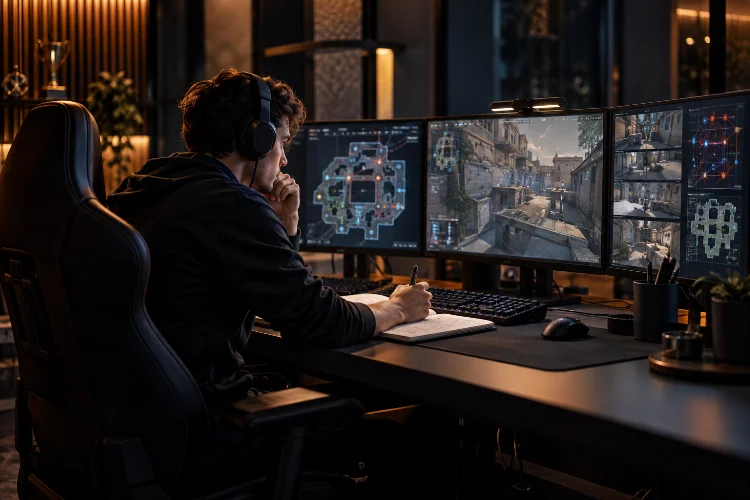
Players can deliberately accelerate this process through replay review.
Pause a VOD before an important event and predict what happens next.
Where will the opponent rotate?
Which player becomes vulnerable?
What resource will probably be used?
Then continue the replay and compare the prediction with reality.
That turns passive watching into active tactical learning.
4. Train Decision-Making Instead of Memorizing Answers
Competitive games rarely provide exactly the same situation twice.
That makes memorizing fixed answers dangerous.
Players need principles that help them solve new problems quickly.
Recent research on semi-professional League of Legends players identified 21 heuristic units across five core cognitive demands during teamfights.
These experience-based shortcuts helped players interpret complex situations and make rapid decisions. Several were shared across team members, suggesting common understanding within the team.
This provides an interesting model for advanced training.
Instead of memorizing, “When X happens, always do Y,” players can develop flexible rules such as:
“If the opponent spends multiple major resources without gaining position, look for an immediate counter-window.”
The rule can transfer across many situations.
High-level decision-making becomes more effective when players understand why a response works.
5. Use Feedback Loops to Find Hidden Weaknesses
One of the biggest problems elite players face is that obvious mistakes become less common.
Weaknesses become subtle.
Maybe positioning is slightly too aggressive after gaining an advantage. Perhaps communication becomes less precise when the team is behind. Maybe mechanical accuracy declines late in long series.
These problems require structured feedback.
A useful development cycle is:
Perform → Review → Diagnose → Train → Retest
VOD reviews, coach feedback, match statistics, communication recordings, and personal notes can all contribute.
Professional League of Legends coaches interviewed in a 2022 study described player evaluation, tactical development, long practice schedules, fatigue, mental stress, and performance measurement among major coaching concerns.
The challenge is avoiding too much data.
Tracking twenty weaknesses at once usually creates unfocused training.
Choose one or two recurring issues, design practice around them, and test whether the problem actually improves.
6. Improve Communication as an Elite-Level Skill
In team esports, individual skill reaches a ceiling if teammates cannot coordinate effectively.
Communication itself should be trained.
A 2025 study analyzed 4,040 statements across Counter-Strike matches and found that expert teams communicated more frequently and effectively than nonexpert teams.
Expert communication contained more factual and action-related information and showed more balanced participation among teammates.
This suggests that communication quality is not simply about saying more words.
It is about sending useful information quickly.
Teams should review comms the same way they review positioning.
Was the information early enough?
Was it accurate?
Could it have been shorter?
Did teammates understand what action should follow?
Improving this skill can make an entire team appear faster because players spend less time interpreting what everybody else means.
7. Train Skills Under Increasing Pressure
A skill that only works in comfortable practice has not fully transferred into competition.
Elite players need pressure exposure.
Once a mechanic or decision process becomes stable, practice it under more demanding conditions. Add time limits, score pressure, disadvantage situations, unfamiliar opponents, or tournament-style series.
The goal is not making practice miserable.
It is transfering skills from controlled environments into conditions where attention is divided and mistakes have consequences.
This is particularly important for decision-making.
Players often know the correct strategy during replay analysis but fail to identify it quickly enough during a live match.
Pressure practice reduces the distance between knowing and doing.
8. Support Skill Development Outside the Game
Gaming skill does not exist separately from the physical and cognitive state of the player.
Recent research suggests structured exercise may support several capacities relevant to esports.
A 2026 systematic review found that acute physical exercise was associated with improvements in outcomes including reaction time, executive function, aiming accuracy, and elimination performance, although evidence for long-term direct gaming improvements remained more mixed.
A separate 2026 meta-analysis of 10 randomized controlled trials involving 503 participants reported positive effects of exercise interventions on cognitive processing speed, operational accuracy, executive function, and memory.
That does not mean elite gamers need bodybuilding routines.
Regular aerobic exercise, resistance training, movement, mobility work, good sleep, and adequate recovery can support the systems players rely on during long practice and competition.
More importantly, recovery protects training quality.
There is little value in adding another three hours of practice when mental fatigue has already reduced the quality of every decision.
9. Build an Individual Skill Development System
The final step is combining everything into a repeatable structure.
Elite development should not depend on motivation being unusually high on a particular day.
A practical system might begin with performance review, identify one priority weakness, create targeted drills, test the skill in scrims or ranked play, and then evaluate whether the behavior changed.
Players should periodically ask three questions:
What is currently limiting my performance?
What training directly targets that limitation?
What evidence would show that I improved?
Those questions prevent training from becoming endless repetition.
They also help players avoid constantly changing sensitivity, equipment, roles, characters, or strategies whenever results temporarily decline.
Good anaylsis separates temporary variance from genuine weaknesses.
Elite skill development becomes much more predictable once practice is treated as a cycle of experiments rather than an endless grind.
Advanced skill development in elite competitive gaming requires much more than mechanical repetition.
High-level players need targeted practice, reliable mechanics, stronger pattern recognition, flexible decision-making, efficient communication, structured feedback, pressure exposure, and proper recovery.
Research also suggests that esports expertise involves multiple cognitive, sensorimotor, strategic, social, and physical dimensions rather than one universal “gaming skill.”
Start by reviewing your last several competitive sessions and identify one repeated weakness that genuinely affects results.
Then build your next training block around that problem instead of simply adding more gaming hours.
Elite improvement is rarely about doing everything at once. It comes from repeatedly finding the most important limitation, training it deliberately, testing the result, and moving to the next one.

