
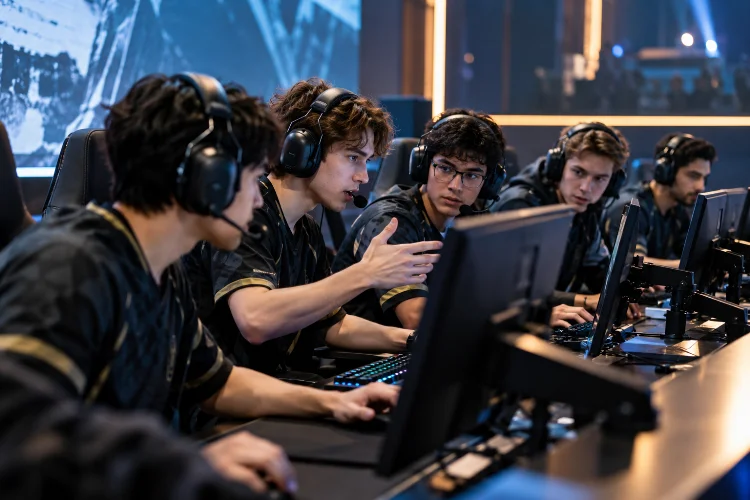
Individual skill can win a duel, but coordinated teams usually win the situations surrounding that duel.
In competitive gaming, players rarely operate in isolation. A successful push, rotation, objective fight, defensive setup, or late-round clutch often depends on several teammates understanding the same situation and acting within seconds of one another.
That is why team coordination shapes competitive gaming performance so strongly.
Mechanical ability still matters, but its value increases when teammates know where to position, when to engage, what information to communicate, and how to respond when the original plan changes.
Research on esports teams increasingly supports this idea. A 2025 systematic review of 92 esports-team studies identified coordination, cooperation, communication, team structure, leadership, and shared psychological states as important parts of team effectiveness.
The strongest teams therefore do more than assemble talented players. They develop shared systems that allow individual skills to combine into something more useful.
Here is how coordination influences competitive performance and how teams can improve it.
1. Coordination Turns Individual Skill Into Team Value
Imagine five mechanically excellent players entering a match without clear coordination.
One player pushes forward while another expects a slower setup. A third uses an important ability too early, while the remaining teammates are not positioned to follow.
Every decision might look reasonable individually.
Together, they create chaos.
Team coordination solves this problem by aligning actions around shared objectives. Players understand what the team is trying to accomplish and how their individual decisions contribute to that goal.
A large 2025 review of esports-team research noted that cooperation and coordination appear repeatedly as important factors in successful team performance across competitive gaming environments.
This is especially important in games where timing windows are extremely small.
A perfectly placed ability can become worthless if teammates arrive two seconds late. A tactical entry can fail if nobody is prepared to trade. A good objective call can collapse if half the team interprets it differently.
Coordination makes individual actions connect.
2. Clear Communication Reduces Decision-Making Friction
Teams obviously need communication, but simply talking more does not guarantee better performance.
The quality of information matters.
A 2025 study analyzed 4,040 statements across Counter-Strike matches and found that expert teams communicated more frequently and effectively than nonexpert teams.
Their communication focused heavily on factual and action-related information, while speaking responsibilities were also distributed more evenly between teammates.
That difference is important.
Useful competitive communication reduces the amount of interpretation players need to perform.
Instead of saying, “I think they might be going somewhere around the left side,” a player might communicate, “Two left, one low, utility used.”
The second version is faster and immediately actionable.
Research involving university-affiliated Overwatch teams also found that more streamlined declarative communication was associated with perceived improvements in response speed and team performance.
Good communication is not conversation.
It is information delivery.
3. Shared Mental Models Help Teams Think Together
Some of the best coordinated plays look almost automatic.
Players move before a long call is needed. One teammate creates space while another immediately fills it. Defensive positions adjust at almost the same moment.
This often comes from what researchers call a shared mental model.
A shared mental model means teammates have a similar understanding of the game state, strategy, responsibilities, and likely next actions.
A systematic review of esports-team structures describes team cognition as shared knowledge about individual and team tasks. Match reviews, repetition, previous experience, self-awareness, and precise communication can all help develop this understanding.
Why Shared Understanding Saves Time
Suppose a tactical FPS team sees opponents use several pieces of utility on one part of the map.
An inexperienced team might require a long discussion before deciding whether to rotate.
An experienced roster may immediately understand the strategic implication because everyone has previously practiced that situation.
The same concept appears in MOBAs.
A recent study examining expert League of Legends teamfight decision-making identified 21 heuristic units across five cognitive demands.
Several heuristics appeared across multiple team members, suggesting that expert players can develop shared ways of interpreting complex fights.
Coordination becomes faster when teammates do not need to explain every assumption.
4. Role Clarity Prevents Overlapping Decisions
Good teams know who is responsible for what.
That sounds simple, but unclear responsibilities create surprisingly large problems.
Two players may both assume they should initiate an engagement. Nobody may track an important opponent ability because everyone thinks someone else is doing it.
Strong coordination requires clearly defined roles without making players rigid.
A tactical shooter might have an in-game leader directing broader strategy while individual players communicate immediate information from their positions.
A MOBA team might give one player primary responsibility for objective timing while another manages initiation.
The exact system depends on the game.
What matters is reducing uncertainty around responsibility.
Research on esports team structures repeatedly highlights collective strategy, tactical discipline, communication, and understanding individual responsibilities as important components of team performance.
Role clarity gives players freedom because they know where their attention should go.
5. Timing Can Matter More Than Mechanical Perfection
Competitive players often spend enormous amounts of time improving mechanics.
That is valuable, but team games contain situations where synchronized average actions outperform disconnected excellent ones.
Consider an engagement where five players must attack simultaneously.
If four players execute perfectly but the fifth enters several seconds late, the entire fight can collapse.
Timing creates numerical advantages.
Teams can briefly turn a five-versus-five situation into five-versus-three simply because two opponents are unable to respond quickly enough.
That is why high-level coordination often revolves around specific triggers.
A particular ability might signal the engagement. Crossing a certain map position might trigger a rotation. An opponent using a major cooldown might automatically create an attack window.
The better the team understands these triggers, the less verbal coordination is required.
This makes the team faster without requiring individual players to physically react faster.
6. Trust Allows Players to Commit Fully
Coordination becomes difficult when players constantly doubt whether teammates will perform their responsibilities.
Imagine initiating a risky engagement while wondering whether your support player will follow.
That hesitation changes timing.
Trust allows players to commit because they expect teammates to execute their side of the plan.
Research comparing esports and traditional sports teams has examined relationships between trust, collective efficacy, shared mental models, and team performance, showing how closely these team-level factors can interact.
Trust does not mean blindly assuming teammates will never make mistakes.
It means understanding how they normally respond.
Repeated practice develops that predictability.
After hundreds of coordinated situations, players start learning how aggressively teammates position, when they retreat, which risks they accept, and how they react under pressure.
That familiarity can create smoother, more consistant team play.
7. Strong Teams Coordinate Adaptation, Not Just Plans
A strategy works until the opponent understands it.
Then the real test begins.
Weakly coordinated teams often adapt individually. One player becomes more aggressive, another slows down, while someone else continues following the original plan.
The result is fragmented play.
Strong teams adapt collectively.
If the opponent begins countering one area, everyone understands how the team’s priorities change. Resources, rotations, positioning, and tempo adjust together.
This is where coordination becomes more than rehearsing set plays.
Teams need principles that survive unexpected situations.
For example, players might understand that losing map control automatically shifts priority toward information gathering rather than immediate aggression.
These shared rules provide structure even when the exact scenario was never practised.
That makes adaptation quicker and less chaotic.
8. Review Coordination, Not Only Individual Statistics
Post-match analysis often focuses heavily on kills, damage, accuracy, assists, or other personal statistics.
Those numbers matter, but they can miss coordination problems.
A player may die because a teammate rotated late.
Someone may have low damage because their responsibility was creating space rather than finishing kills.
A failed team fight may begin with poor positioning fifteen seconds before anyone actually takes damage.
Team reviews should therefore examine sequences rather than isolated outcomes.
Ask when players started moving, what information was communicated, whether responsibilities were understood, and whether everyone interpreted the same situation similarly.
The 2025 systematic review of esports research highlights the usefulness of rich sources such as gameplay logs, audio recordings, and video footage for understanding team dynamics.
Replay analysis becomes much more valuable when teams look beyond individual mistakes.
Sometimes the real problem is not execution.
It is coordiantion.
9. Build Coordination Through Deliberate Practice
Team chemistry should not be left entirely to chance.
Coordination improves when teams deliberately practice situations that require shared responses.
Instead of only playing complete scrimmages, teams can isolate scenarios.
Practice attacking an objective after losing one player. Repeat defensive rotations when information is incomplete. Rehearse late-game engagements where several players must coordinate abilities within a narrow window.
Then review what happened.
Was the call clear?
Did everyone understand the trigger?
Were players early or late?
Could fewer words produce the same response?
Over time, these repetitions build shared expectations.
Research on esports team cognition suggests that repetition, match review, communication practice, and discussion of different perspectives can contribute to stronger shared understanding.
The goal is not making players robotic.
It is making common situations feel familiar enough that more mental attention remains available for unusual ones.
Team coordination transforms competitive gaming from a collection of individual actions into a shared performance system.
Strong teams communicate useful information, understand each other’s responsibilities, synchronize timing, develop shared mental models, build trust, and adapt together when matches stop following the original plan.
Those skills rarely appear automatically just because talented players spend time together.
They require deliberate practice.
If you want to improve your own competitive team, review one recent match without focusing on kills or mechanical mistakes. Instead, examine communication, timing, rotations, role clarity, and how players responded to changing situations.
You may discover that many apparent individual errors actually began as team coordination problems.
Fix those patterns, and individual skill suddenly becomes much more powerful.

