
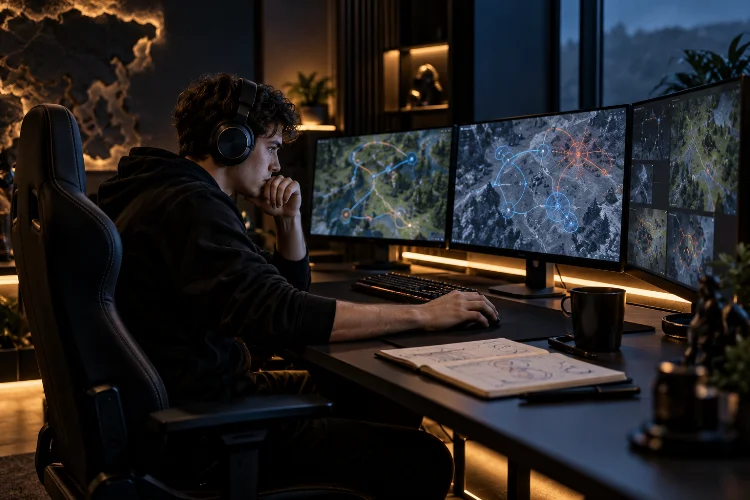
Competitive gaming changes dramatically once you move beyond the intermediate level. Mechanical skill still matters, but simply clicking faster, aiming better, or grinding more matches is rarely enough to keep climbing.
At higher ranks, opponents already understand the fundamentals. They know common rotations, standard matchups, popular strategies, timing windows, and basic resource management.
The difference between winning and losing may come from a decision made several seconds before the actual fight begins.
That is why advanced competitive gaming strategies for high-level players are increasingly about efficiency, anticipation, adaptation, and consistency rather than raw playtime.
Whether you compete in FPS titles, MOBAs, tactical shooters, fighting games, RTS games, or other esports, high-level improvement requires a more systematic approach.
You need to understand not only what happened during a match, but why it happened, what information was available beforehand, and how you could respond differently next time.
Here is how experienced players can push performance further.
1. Stop Practicing Everything at the Same Time
One of the biggest mistakes experienced players make is assuming that more matches automatically produce more improvement.
They usually do not.
General play provides experience, but targeted practice develops specific weaknesses.
The idea is similar to deliberate practice: training should have a defined objective, immediate feedback, and enough difficulty to force adaptation rather than simply repeating comfortable actions.
Research on expertise also distinguishes purposeful practice from mindless repetition.
Instead of playing ten ranked games with the vague goal of “getting better,” dedicate sessions to one problem.
An FPS player might focus specifically on crosshair placement when clearing angles. A MOBA player could concentrate on wave management before major objectives. A fighting-game player might spend a session recognizing one troublesome matchup.
Build Narrow Training Objectives
Try creating one measurable objective before each session.
Rather than saying, “I want better positioning,” use something like, “I will review every death caused by entering an area without sufficient information.”
This makes progress easier to analzye because you know exactly what behavior you are tracking.
2. Learn to Read the Game Before the Action Happens
Elite players often appear faster than everyone else, but reaction speed is only part of the explanation.
They are frequently anticipating what is likely to happen.
A tactical shooter player who expects an opponent to appear from one of two positions requires less processing time than someone mentally considering eight possibilities.
Similarly, a MOBA player tracking enemy cooldowns, vision, resources, and map movement can predict an engagement before it begins.
The objective is to reduce uncertainty.
Ask yourself what information is currently available, what the opponent wants to accomplish, and which options make the most sense from their perspective.
This creates a mental probability map.
Instead of reacting to everything equally, you become prepared for the most likely scenarios while remaining flexible enough to handle unusual ones.
Research examining competitive esports highlights attention, working memory, executive control, and decision-making as important components of high-level play, although researchers also caution that the science of esports expertise is still developing.
3. Review Decisions, Not Just Mistakes
VOD review is common among serious players, but many players use it badly.
They watch themselves die and immediately conclude, “My aim was terrible.”
Sometimes that is true. But the useful question is what happened ten or twenty seconds before the mechanical duel.
Maybe your positioning forced an unfavorable fight. Perhaps you ignored information from the minimap. Maybe you used an important ability too early or failed to recognize the opponent’s economy.
Use Decision Chains
When reviewing a match, trace important moments backward.
Start with the outcome, then ask what decision created that situation. Continue backward until you identify the earliest meaningful mistake.
A lost team fight might actually have started with poor resource management thirty seconds earlier.
This method shifts your attention from visible mistakes to underlying causes. High-level players improve faster when they correct repeated decision patterns instead of treating every death or lost round as an isolated event.
4. Develop Adaptation as a Competitive Skill
A strategy can be excellent and still stop working.
Strong opponents notice patterns quickly.
If you repeatedly attack the same area, rotate at similar timings, select predictable openings, or respond identically under pressure, experienced players will exploit those habits.
High-level competitive gaming therefore requires strategic flexibility.
Think in terms of patterns and counter-patterns. When something works, ask why it worked and whether your opponent can adapt to it. When they adjust, have another option prepared.
This does not mean becoming completely unpredictable. Random decisions often create unnecessary mistakes.
The goal is controlled variation.
Your fundamentals remain stable, but your tactical choices change according to opponent behavior, game state, map conditions, resources, and previous interactions.
Players who adapt consistantly are much harder to prepare against than players who simply execute one excellent strategy.
5. Improve Communication Efficiency
In team-based esports, communication is another performance skill.
More communication is not automatically better communication.
During high-pressure situations, teammates need information that is short, specific, and actionable. Long explanations increase cognitive load and can distract players who are already processing multiple events simultaneously.
Instead of saying, “I think someone might possibly be moving toward our side,” useful competitive communication would identify the player, location, direction, and important resources whenever possible.
Timing matters too.
Some information is useful immediately but worthless three seconds later.
Research on competitive esports has identified communication, adaptation, strategic thinking, attention, and coping under pressure among factors associated with performance environments.
Teams can improve this by developing shared terminology, clear responsibility, and predictable communication protocols.
When everyone interprets a call the same way, fewer mental resources are wasted translating what teammates mean.
6. Protect Your Cognitive Performance
Competitive gaming is cognitively demanding.
Players continually process visual information, track changing objectives, predict opponents, control fine movements, communicate with teammates, and make decisions under time pressure.
That creates mental fatigue.
A 2026 review covering 48 competitive esports studies described cognitive overload as a multidimensional issue involving workload, stress, fatigue, arousal, sleep, attention, and performance rather than one simple condition.
This is why playing while mentally exhausted can become deceptive. You may still execute familiar mechanics, while your decison quality slowly deteriorates.
Recovery therefore belongs inside a competitive training system.
Sleep is especially relevant. Research involving Counter-Strike players found associations between better game performance and longer sleep duration, although the small observational sample means the results should not be treated as proof of causation.
Knowing when to stop practicing can sometimes be as valuable as knowing when to continue.
7. Treat Physical Training as Performance Support
Competitive gaming may happen while sitting down, but physical condition can still influence cognitive performance.
Recent research has started examining this connection more directly.
A 2026 systematic review of 12 experimental studies found that acute physical exercise was associated with improvements in several esports-related measures, including reaction time, executive function, aiming accuracy, and elimination performance.
Long-term interventions showed more mixed direct gaming results, so the evidence should still be interpreted carefully.
Another 2026 meta-analysis covering 10 randomized controlled trials and 503 participants reported positive effects of exercise interventions on reaction time, operational accuracy, executive function, and memory among esports players.
That does not mean players need to train like professional marathon runners.
Regular movement, aerobic activity, resistance exercise, mobility work, and breaks from prolonged sitting can become part of a broader performance routine.
The important idea is simple: competitive gaming performance does not exist separately from the person controlling the keyboard, controller, or mouse.
8. Build a Performance Feedback Loop
The strongest improvement systems create a loop:
Play → Measure → Review → Identify → Practice → Test
After a training block, identify one or two recurring problems rather than creating a huge list of everything that went wrong.
Then design practice around those problems.
For example, imagine your review shows that you regularly lose fights after taking unnecessary early damage. Your next practice block should not simply contain more ranked matches.
It should focus on positioning, information gathering, spacing, or whatever behavior is actually causing that damage.
After several sessions, review the same metric again.
This converts improvement from guesswork into experimentation.
The process also prevents players from endlessly changing sensitivity settings, equipment, characters, roles, or strategies whenever results temporarily decline.
High-level progress is rarely perfectly linear. A good system helps you distinguish temporary variance from a genuine weakness that needs attention.
Advanced competitive gaming is less about discovering one secret technique and more about building a better performance system.
High-level players need strong mechanics, but they also need anticipation, efficient communication, structured VOD review, tactical adaptation, physical recovery, and focused practice.
The biggest improvements often come from understanding why decisions succeed or fail rather than simply increasing total hours played.
Start by identifying one recurring weakness from your recent matches. Build a focused training objective around it, measure the result, and review your progress after several sessions.
Do that repeatedly and your training becomes far more strategicly useful than simply grinding ranked games without direction.
The goal is not to play more. It is to make every serious practice session teach you something.

