
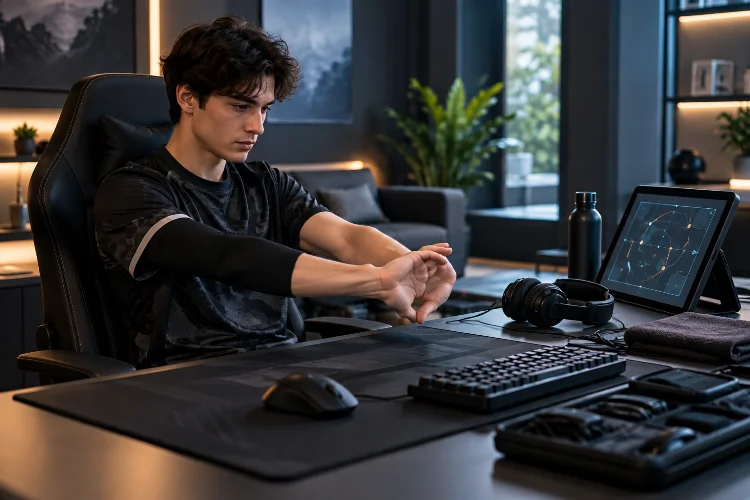
At high levels of competitive gaming, preparation begins long before the first round, draft, map, or match actually starts.
Players may have excellent mechanics, thousands of hours of experience, and deep game knowledge, yet still perform below their potential when match-day preparation is inconsistent.
That is why advanced match preparation for high-level competitive players should be treated as a complete performance system rather than a quick warm-up before joining the server.
Professional preparation combines opponent scouting, tactical review, mechanical activation, sleep and recovery, communication routines, equipment checks, and mental readiness. Each element removes a small amount of uncertainty before competition begins.
This matters because competitive environments already create enough unpredictability. Opponents change tactics, unexpected mistakes happen, and pressure can influence decision-making.
Players cannot control all of those variables. They can, however, control much of what happens before the match.
A strong preparation routine therefore has one simple purpose: arrive at competition physically comfortable, mentally focused, strategically informed, and ready to adapt.
1. Start Match Preparation Before Match Day
Waiting until an hour before competition to start preparing is usually too late.
High-level preparation should begin during the previous training cycle. Players need time to study opponents, test strategies, identify weak areas, and gradually reduce uncertainty about how they want to approach the match.
Research involving 1,835 esports players found that training structures vary considerably between games and highlighted the importance of game-specific skills, tactical knowledge, coordination, and other performance components.
This means preparation should match the demands of the title.
An FPS player might prioritize aim consistency, map positioning, utility usage, and opponent tendencies. A MOBA player may spend more time reviewing drafts, lane matchups, objective timing, and rotation patterns.
Create a Preparation Timeline
Instead of treating preperation as one session, divide it across several stages.
Earlier sessions can focus on strategic analysis and experimentation. The final day should usually involve confirmation, light practice, and refinement rather than suddenly rebuilding the entire game plan.
Constantly introducing new strategies immediately before competition can increase uncertainty when players should be developing confidence.
2. Scout Opponents for Patterns, Not Trivia
Opponent research is useful only when it changes how you play.
Knowing that an opposing player prefers a particular character or weapon is interesting. Knowing how that preference affects positioning, timing, rotations, or resource allocation is strategically valuable.
High-level scouting should therefore search for repeatable tendencies.
Look at how opponents open rounds, respond after losing an early engagement, manage resources, defend objectives, rotate between areas, and change pace when leading or trailing.
Then ask what those patterns allow your team to do.
For example, suppose an opponent frequently commits extra players to one side of a map after seeing early utility. Your team might prepare a fake that encourages that rotation before attacking the weaker area.
The goal is not to memorize everything an opponent has ever done.
It is to discover a small number of behaviors that can influence real decisions during the upcoming match.
3. Use Warm-Ups to Activate Skills, Not Exhaust Them
A common mistake among competitive players is turning the warm-up into another full training session.
The purpose should be readiness, not fatigue.
For mechanically demanding games, players can begin with controlled movements before gradually increasing speed and difficulty.
FPS competitors might move from basic tracking or precision drills toward short deathmatch sessions. Fighting-game players may rehearse movement, combos, defensive responses, and matchup-specific situations.
Physical activation may also have a role.
A 2026 systematic review of 12 experimental studies found that acute physical exercise was associated with improvements in several esports-related outcomes, including reaction time, executive function, aiming accuracy, and elimination performance, although the researchers noted that evidence on longer-term direct performance effects remains mixed.
This does not mean doing an exhausting workout five minutes before competition.
A short walk, light mobility session, or moderate physical activity earlier in the routine may help players feel more alert without creating unnecessary fatigue.
4. Protect Sleep and Recovery Before Competition
Mechanical warm-ups cannot fully compensate for poor recovery.
Sleep deserves particular attention because competitive gaming depends heavily on attention, reaction speed, working memory, and decision-making.
A study monitoring 27 Counter-Strike players for 56 days found that better-performing players tended to spend more time sleeping, although the observational design means this should not be interpreted as simple proof that extra sleep directly caused stronger performance.
Research involving professional esports athletes has also identified delayed sleep schedules and relatively short sleep duration as common issues. In one multinational sample of 17 professional FPS players, median total sleep time was approximately 6.8 hours.
Interestingly, an experimental Rocket League study found that roughly 29 hours of total sleep deprivation reduced alertness and cognitive response speed but did not significantly worsen overall in-game performance in that specific experiment.
The practical lesson is not that sleep is unimportant.
It is that esports performance is complex. Players should build consistant sleep and recovery habits rather than relying on last-minute fixes.
5. Prepare Your Mental State Without Overhyping the Match
Important matches naturally create pressure.
Trying to eliminate every nervous feeling is unrealistic and often counterproductive.
Instead, build a routine that makes competition feel familiar.
A systematic review covering 19 esports studies identified performance pressure, defeat, team problems, organizational issues, and social factors among common sources of stress for competitors.
Players can reduce unnecessary mental load by controlling what they can control before the match.
Keep the routine predictable. Arrive early enough to avoid rushing. Use familiar warm-ups. Review only the most important tactical information rather than reading twenty pages of notes minutes before playing.
A simple pre-match mental cue can also help.
Something like “information first,” “play the situation,” or “next decision” gives attention somewhere useful to return when nerves appear.
Confidence should come from preparation, not from trying to convince yourself that nothing can go wrong.
6. Confirm Team Communication Before the Match
Team communication needs its own warm-up.
High-level players often have established terminology, but communication can still become messy when competition gets intense.
Before the match, confirm important calls, responsibilities, tactical triggers, and leadership structure.
Who makes the final decision during a mid-round situation?
Who tracks specific opponent resources?
Who communicates rotations?
What information should be prioritized during chaotic engagements?
A 2025 study examining 4,040 statements during Counter-Strike matches found that expert teams communicated more frequently and effectively than nonexpert teams.
Expert communication was particularly focused on factual and action-related information and showed a more balanced distribution across players.
Good communcation is therefore not simply about talking more.
It is about giving teammates information that helps them act faster.
A short communication rehearsal before competition can remind everyone what useful communication sounds like.
7. Check Equipment Before It Becomes a Problem
Technical preparation sounds boring until something fails during an important round.
High-level competitors should remove preventable technical variables before entering competition.
Check mouse or controller settings, sensitivity, key bindings, audio levels, display settings, network stability where relevant, peripherals, cables, batteries, and any game-specific configuration permitted by tournament rules.
Do not use match day to experiment with major equipment changes.
A new mouse sensitivity might feel exciting during ten minutes of practice, but unfamiliar settings introduce another variable into an environment that already contains plenty of pressure.
Comfort matters as well.
Monitor position, chair height, arm support, keyboard placement, and posture should feel familiar. Small physical distractions can become surprisingly irritating during long matches.
The best equipment setup is usually the one players barely need to think about once competition begins.
8. Build Contingencies Into the Game Plan
A game plan should provide direction without becoming a script.
Opponents will sometimes do something completely different from what your anaylsis predicted.
That is normal.
Before competition, identify a few important situations where the initial plan might fail.
What happens if the opponent changes tempo?
What if your preferred draft is unavailable?
How will the team respond after losing several rounds quickly?
What changes when playing from a large advantage or disadvantage?
This kind of scenario preparation makes adaptation faster because players are not inventing every response while already under pressure.
High-level teams need both structure and flexibility.
Preparation tells players where to begin. Game awareness tells them when it is time to change.
9. Create a Repeatable Match-Day Routine
The final objective is to turn all these elements into something repeatable.
A practical high-level routine might move through recovery, food and hydration, light physical movement, strategic reminders, mechanical warm-up, communication checks, equipment confirmation, and several quiet minutes before competition.
The exact sequence depends on the player.
What matters is consistency.
A repeatable routine reduces the number of decisions that need to be made on match day. Instead of wondering whether to play another warm-up game, change settings, review another VOD, or test a new strategy, the player already knows what comes next.
Research published in 2026 also describes competitive esports workload as multidimensional, involving interactions between mental workload, stress, fatigue, arousal, sleep, attention, and performance.
Preparation should reflect that complexity rather than focusing exclusively on mechanics.
Advanced match preparation is not about creating an elaborate ritual that makes competition feel more complicated.
It is about removing unnecessary uncertainty.
High-level players benefit from structured opponent scouting, targeted warm-ups, reliable sleep and recovery, mental routines, efficient team communication, stable equipment, and contingency planning.
When these elements become repeatable, players can spend less attention worrying about preparation and more attention reading the actual match.
Start by reviewing your current match-day routine. Identify one variable that regularly creates stress, inconsistency, or distraction, and build a simple process to control it before your next competition.
Then refine the routine over time.
The ultimate goal is simple: when the match starts, preparation should disappear into the background so your full attention can stay inside the game.

