
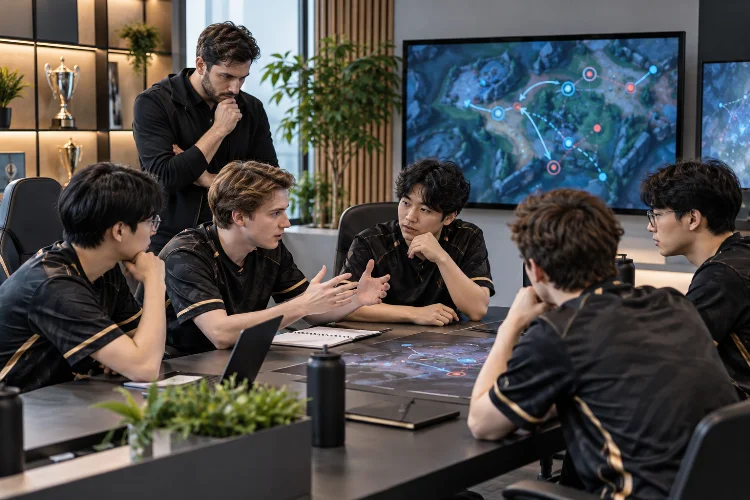
Winning at the professional level rarely comes from simply putting five highly skilled players together and hoping their individual talent solves everything.
Once competitors reach elite levels, the mechanical difference between players can become surprisingly small.
What often separates teams is how well they prepare, communicate, coordinate, adapt, and understand what they are trying to accomplish before the match even begins.
That is where professional teams build winning competitive game plans differently from casual or semi-competitive groups.
Their preparation usually involves coaches, analysts, players, replay footage, performance data, tactical discussions, scrimmages, and clearly defined responsibilities.
The goal is not to create a perfect script for every possible situation. Competitive games are far too unpredictable for that.
Instead, professional teams develop a framework that helps players make faster and more consistent decisions when pressure increases.
Whether the game is Counter-Strike, Valorant, League of Legends, Dota 2, Overwatch, or another team-based esport, the fundamentals of professional game planning share several important principles.
1. Start With Detailed Opponent Scouting
A strong competitive game plan begins long before players enter the server.
Professional teams study their opponents to understand patterns. Analysts may review previous matches, map preferences, drafting tendencies, player positioning, opening strategies, objective timing, economic decisions, and reactions to specific situations.
The important part is not simply collecting information. Teams need to identify patterns they can actually use.
For example, a tactical FPS opponent might repeatedly push aggressively after losing the opening player. A MOBA team may prefer contesting certain objectives even when their resource position is weak.
Recognizing these habits allows coaches to build possible responses.
However, scouting should never become overly rigid. Professional opponents also know they are being studied and may deliberately change familiar patterns during important matches.
Good scouting therefore answers two questions: What does this opponent normally do, and what might they change against us?
2. Build the Plan Around Team Identity
Copying the best team in the world sounds reasonable until you realize their strategy may depend on completely different player strengths.
Professional teams usually perform better when their tactical system matches their roster.
A team with highly aggressive mechanical players might create strategies that produce frequent early engagements.
Another roster with strong communication and disciplined positioning may prefer slower rounds that generate information before committing resources.
Research on esports performance consistently identifies communication, teamwork, game knowledge, cognitive skills, and team dynamics as important parts of competitive performance.
That means strategy should not exist separately from personnel.
Coaches need to understand which players make excellent initiators, who remains composed during chaotic situations, who gathers information effectively, and who performs best when making late-game decisions.
The strongest game plan usually amplifies existing strengths rather than forcing players into uncomfortable roles.
3. Give Every Player Clear Responsibilities
A professional strategy becomes useless when multiple players expect someone else to perform the same job.
Role clarity reduces hesitation.
Before competition, teams need to understand who controls certain areas, who initiates specific actions, who communicates key information, and who has final authority when the original plan breaks down.
Shared Leadership Still Matters
Clear roles do not necessarily mean one player makes every decision.
Modern esports communication can be highly distributed. A 2025 study analyzing 4,040 statements across Counter-Strike matches found that expert teams communicated more frequently and effectively than nonexpert teams.
Expert communication was also more balanced across team members rather than being dominated by only one speaker.
This suggests effective teams can combine leadership with shared responsibility.
One player may make the primary strategic call, while teammates provide immediate tactical information based on what they see.
The objective is to remove confusion without removing initiative.
4. Turn Communication Into a Tactical System
Professional communication is very different from simply talking constantly.
Players have limited attention during competition. They are processing movement, cooldowns, resources, enemy positions, objectives, timing, sound cues, and teammate actions simultaneously.
Every unnecessary sentence competes for mental bandwidth.
Research comparing expert and nonexpert esports players found that experts relied heavily on factual and action-related statements. Their communcation was faster, more task-focused, and more evenly distributed.
Another study involving Overwatch teams found that more streamlined declarative communication was associated with perceived improvements in response speed and overall team performance.
Professional teams therefore develop communication rules.
Players often use short terminology for locations, tactical movements, abilities, targets, or timing. Everyone understands exactly what those calls mean.
Instead of explaining an entire situation, one familiar phrase can trigger a coordinated response from multiple teammates.
That efficiency becomes incredibly valuable when decisions must happen within seconds.
5. Prepare Situations, Not Just One Perfect Strategy
One common misconception is that professional game plans are detailed scripts covering every second of competition.
In reality, rigid plans can collapse quickly.
An opponent may choose an unexpected composition, score an early advantage, change positioning, reveal a new tactic, or simply win an engagement that was statistically unfavorable.
Professional preparation therefore focuses heavily on scenarios.
Teams might rehearse how they respond when playing from behind, protecting an advantage, losing an important player early, controlling limited resources, defending an objective, or facing an unexpected opponent strategy.
This creates what could be described as a tactical library.
Players do not need to invent every solution from scratch during competition. They recognize the situation and select an appropriate response they have already practiced.
That makes decision-making faster and more reliable under pressure.
6. Use Scrimmages to Stress-Test the Game Plan
Practice matches are not simply opportunities to win against another team.
Professional scrimmages are testing environments.
A team may intentionally practice one map, composition, opening sequence, defensive setup, or objective strategy repeatedly. The coaching staff can then evaluate whether the concept works under realistic resistance.
Research into esports coaching shows professional teams increasingly use structured preparation involving coaches, analysts, gameplay practice, replay review, and other specialized support roles.
The important distinction is between practicing execution and testing assumptions.
Suppose a team believes a particular defensive setup creates strong control around an objective. Scrimmages may reveal that the strategy works against slow opponents but collapses against aggressive early pressure.
That information allows the coaching staff to modify the plan before tournament day.
Good teams are not emotionally attached to strategies simply because they looked impressive during theory sessions.
They test them.
7. Use Data Without Ignoring Context
Competitive esports produces enormous amounts of information.
Teams can track player movements, positioning, damage, resource use, map control, objective timing, accuracy, engagements, and countless game-specific metrics.
But statistics need context.
A player having lower damage numbers does not automatically mean they performed badly. Their role may require creating space, gathering information, supporting teammates, or controlling an important area.
Recent research using behavioral data from 80 professional gamers across 16 esports teams found measurable coordination patterns associated with offensive and defensive outcomes.
The study illustrates how digital trace data can help teams evaluate teamwork rather than relying exclusively on individual statistics.
That is an important lesson for competitive anaylsis.
Metrics are most useful when coaches connect them to tactical objectives.
Instead of asking, “Who had the best numbers?” ask, “Did our strategy produce the situation we wanted?”
8. Build Adaptation Into the Original Plan
Even excellent preparation becomes dangerous when teams refuse to abandon it.
Professional opponents adapt quickly.
If one strategy succeeds twice, the other team will probably start searching for the pattern. They may change positioning, resource allocation, tempo, or player responsibilities specifically to counter it.
A winning team therefore needs several layers of response.
The initial game plan might be called Plan A. But professional preparation should also include what happens when the opponent understands Plan A.
That may involve changing tempo, creating false information, switching targets, rotating earlier, altering drafts, or intentionally repeating a pattern before suddenly breaking it.
Adaptablity becomes part of preparation rather than something players improvise after disaster strikes.
The best tactical systems provide structure without making the team predictable.
9. Review the Process After Every Match
Winning does not automatically mean the strategy was good.
Losing does not automatically mean it was bad.
Professional teams review both results and process.
A team might execute an excellent strategy but lose because of one mechanical mistake. Another team could make several poor decisions but still win because an opponent made an even larger error.
These situations require different responses.
Coaches and analysts often use replay review to examine rotations, communications, positioning, resource management, tactical execution, and decision timing.
A systematic review of esports-team research notes that structured training increasingly incorporates replay analysis and game-footage review alongside regular gameplay.
This creates a useful feedback cycle:
Prepare → Execute → Measure → Review → Adjust → Practice
Over time, teams build stronger shared knowledge about what works, when it works, and why it fails.
That cycle is what turns preparation into sustainable competitive improvement.
Professional teams build winning competitive game plans by combining preparation with flexibility.
They study opponents, understand their own strengths, assign clear responsibilities, develop efficient communication systems, test strategies through scrimmages, analyze meaningful performance data, and prepare alternative responses before competition begins.
Most importantly, they do not treat strategy as a fixed document.
A strong game plan is a living system that changes as opponents adapt, patches modify the game, team strengths evolve, and new tactical information becomes available.
If you are building your own competitive team, start with one upcoming opponent. Review several matches, identify three repeated patterns, design responses, test them in practice, and analyze what actually happened.
That simple process is already much closer to professional preparation than simply entering the next match and hoping individual skill carries the team.

