
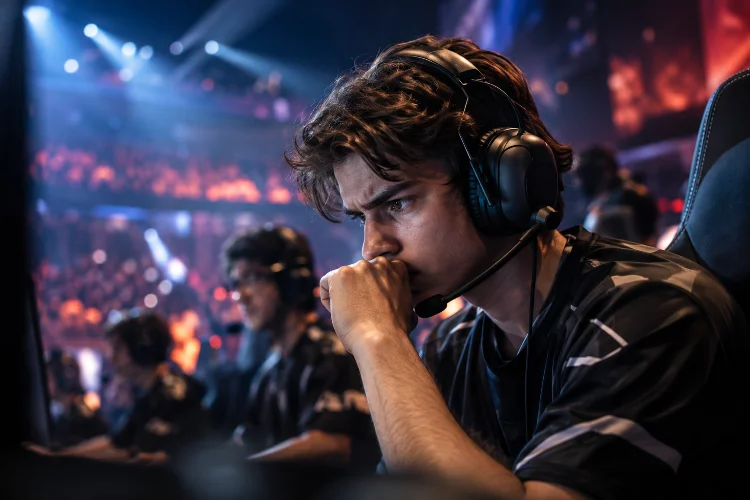
A tournament is tied. Your team has limited resources, the opponent is applying pressure, the clock is disappearing, and one wrong move could decide the entire match. You may have only second – or fractions of a second – to choose what happens next.
This is where competitive gaming becomes much more than mechanical execution.
Strategic decision making under pressure in competitive gaming involves processing information, controlling emotional reactions, predicting opponents, communicating with teammates, and selecting an effective action while time and information are limited.
Professional and high-level players are not immune to pressure either.
Research using professional CS competition data found performance declines during particularly high-pressure overtime situations, showing that even experienced competitors can be affected when the stakes rise.
The good news is that decision-making under stress is trainable. Players can develop better routines, simplify complicated situations, improve risk assessment, and become more comfortable making difficult choices when matches become chaotic.
Here is how that process works.
1. Understand What Pressure Does to Your Decisions
Pressure does not simply make players nervous. It can change how they process information.
Competitive gaming requires attention to many things simultaneously: enemy positions, cooldowns, health, resources, objectives, timers, teammates, audio cues, and possible future actions.
Adding tournament stakes or fear of making a mistake increases the mental load even further.
A systematic review of esports research identified performance pressure, defeat, team issues, organizational factors, and social pressures among commonly reported competitive stressors.
Under intense pressure, players may start rushing decisions or become unusually passive.
Both reactions can be damaging.
A player who normally checks three pieces of information before engaging might suddenly attack after seeing only one. Another player may hesitate so long that the best opportunity disappears.
The first step toward better pressure management is recognizing how your own decision style changes.
2. Reduce Complicated Situations Into Simple Questions
Trying to calculate every possible outcome during a live match is impossible.
Strong competitors simplify complexity.
Instead of asking, “What are all the things that could happen here?” they focus on a smaller number of high-value questions.
What information do we actually have?
What does the opponent probably want?
What resources are available?
What happens if this play fails?
These questions create structure when the situation feels chaotic.
Use Decision Priorities
Imagine a MOBA team deciding whether to contest a major objective.
The decision should not depend only on whether the objective is valuable. Players also need to consider numbers advantage, positioning, vision, key cooldowns, health, and whether an alternative objective exists.
A tactical shooter presents the same principle differently.
A player in a one-versus-two situation might evaluate time, opponent positions, available utility, weapon advantage, and whether saving equipment has greater strategic value than attempting a low-probability clutch.
Good decision-making is often about eliminating bad options quickly.
3. Build Recognition Through Repeated Scenarios
Fast decisions do not always mean players are consciously thinking faster.
Often, they recognize familiar situations sooner.
Experienced competitors have seen thousands of combinations involving positioning, timing, abilities, rotations, and opponent behavior. That experience creates mental patterns that allow them to recognize situations without rebuilding the entire problem from zero.
Research supports the broader cognitive difference between experienced and less experienced competitors.
A 2024 meta-analysis covering 15 studies, 1,085 participants, and 142 effect sizes found a small overall cognitive advantage among esports experts, particularly in spatial cognition and attention.
This is why scenario practice matters.
Instead of only playing full ranked matches, practice specific situations repeatedly.
A fighting-game player can rehearse responses after being trapped in the corner. An FPS team can repeatedly practice three-versus-four retakes. A MOBA team can simulate late-game objective setups with limited vision.
Repetition reduces the number of completely unfamiliar decisions players face.
4. Separate Good Decisions From Good Outcomes
One of the most important competitive skills is understanding that a good decision can produce a bad result.
Suppose you take a fight with an 80% chance of success.
You can still lose.
That does not automatically make the decision wrong.
The opposite problem also happens. A player makes an unnecessary, extremely risky move but succeeds because the opponent misses several shots.
The result looks great, but the process was poor.
Review the Expected Value of Decisions
After important matches, review your choices without focusing only on whether you won or lost.
Ask whether the available information supported your action.
Did you understand the risk?
Were safer alternatives available?
Did the potential reward justify the downside?
This prevents results-oriented thinking from reinforcing bad habits.
High-level players want repeatable decisions, not lucky outcomes.
5. Control Risk According to the Game State
Not every moment requires the same level of aggression.
A team that is far behind may need to accept greater risk because conservative play simply leads to a slow defeat. A team with a strong advantage may benefit from reducing unnecessary variance.
Consider a tactical shooter where your team leads comfortably and has superior equipment.
Attempting an individual highlight play might create a small chance of gaining an extra kill, but it can also give the opponent a free opening.
The strategic question becomes: Do we actually need this risk?
The same principle applies across competitive genres.
Strong players dynamically adjust their risk tolerance according to score, resources, time, opponent tendencies, and win conditions.
This sounds obvious outside the game. Under preassure, however, players regularly forget it.
6. Make Communication Reduce Mental Load
Team communication should simplify decisions rather than create additional noise.
Five people talking at once can make a difficult situation harder.
Effective teams communicate information that helps somebody make the next decision. That may include opponent locations, missing resources, objective timing, intentions, or immediate threats.
Professional esports research has repeatedly highlighted teammate communication and team-related issues as important parts of competitive stress and performance.
A diary study involving elite League of Legends players found that performance-related and teammate-related stressors together accounted for 72.3% of the reported stressors in that sample.
Clear communcation helps transform five separate perspectives into shared information.
Instead of saying:
“They’re probably coming and I don’t really know what we should do.”
A useful call might be:
“Three rotating left. Twenty seconds. Hold position.”
Short calls provide information without forcing teammates to process unnecessary language.
7. Develop a Reset Routine After Mistakes
One mistake frequently becomes three because players continue mentally replaying the first one.
They miss an easy shot.
Then they think about missing it.
Their attention shifts away from the current round, causing another poor decison.
Now frustration arrives.
This cycle is a classic competitive problem.
Qualitative research involving amateur and professional esports players has documented choking experiences and the role that pressure can play in critical underperformance.
A reset routine interrupts the cycle.
It can be surprisingly simple: one controlled breath, a physical posture adjustment, a short internal cue such as “next play,” and immediate attention to current information.
The purpose is not pretending the mistake never happened.
Analysis belongs after the round or match. During competition, the priority is recovering enough attention to make the next decision correctly.
8. Train Decision-Making Under Artificial Pressure
Players often practice mechanics in comfortable conditions and then wonder why tournament performance feels completely different.
Training should sometimes recreate pressure.
Introduce time limits, score consequences, disadvantage scenarios, unfamiliar situations, or controlled distractions. The objective is not making every practice session stressful, but creating enough exposure that pressure becomes familiar.
A 2026 randomized study involving 184 competitive esports athletes compared standard gaming practice with an individualized program combining cognitive self-regulation and physical training.
The intervention group showed greater improvements in reaction-time and decision-making measures under controlled conditions, although the authors noted that further confirmatory research is needed.
The practical lesson is useful: gameplay volume alone is not necessarily the best way to train cognitive performance.
Structured pressure practice can target specific weaknesses much more directly.
9. Create Your Own Pressure Decision Framework
You do not need a complicated psychological system.
Build a simple framework you can remember during matches.
A useful sequence is:
Information → Objective → Risk → Action → Reset
First, identify what you know.
Second, remember the current objective.
Third, evaluate the downside of your options.
Fourth, commit to the chosen action instead of hesitating halfway through.
Finally, reset mentally regardless of the outcome.
The exact framework can vary by game and role. What matters is using it consistantly until the process becomes automatic.
When pressure rises, simple systems usually survive better than complicated theories.
Strategic decision making under pressure is one of the clearest differences between simply knowing a competitive game and performing well when the result actually matters.
Strong players learn to simplify complex situations, recognize familiar patterns, evaluate risk according to game state, communicate efficiently, recover quickly from mistakes, and judge decisions separately from outcomes.
None of these skills requires perfect emotional control. Pressure is part of competition, and even professional players can experience performance declines in high-stakes situations.
The goal is to build routines that still work when your heart rate rises and the match becomes chaotic.
Start by reviewing three high-pressure moments from your recent games. Identify what information you had, what choice you made, and what you would repeat or change. That habit can turn pressure from an unpredictable enemy into another part of your competitive training.

