
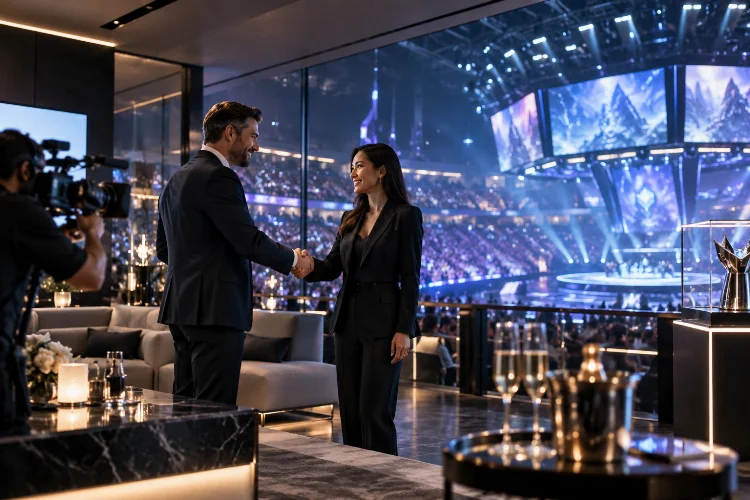
Sponsorship in esports used to look fairly simple: put a brand logo on the broadcast, mention the sponsor during a show segment, and display a few banners around the venue.
That model is changing quickly.
Modern global tournaments operate across livestreams, arenas, social platforms, creator ecosystems, websites, mobile devices, and sometimes several game titles at once.
This gives brands far more ways to connect with fans – but it also makes sponsorship strategy much more complicated.
That is why advanced sponsorship models for global eSports competitions increasingly focus on long-term integration rather than short-term exposure.
Recent deals show this shift clearly. ESL FACEIT Group renewed its long-running Intel relationship on a multi-year basis in 2025, extending a partnership that had already existed for 24 years.
Meanwhile, DreamHack and Elgiganten announced a five-year extension in 2026 covering presenting and exclusive retail rights.
The lesson is simple: the strongest esports sponsorships increasingly behave like business partnerships, not temporary advertising packages.
1. Multi-Year Partnerships Create More Strategic Value
A one-event sponsorship can generate visibility.
A multi-year agreement can build association.
That difference matters because fans usually need repeated exposure before they strongly connect a brand with a tournament, team, or gaming ecosystem.
Long-term deals also make planning easier for both sides.
Tournament organizers gain more predictable commercial revenue, while sponsors can develop campaigns across several seasons instead of rebuilding everything for each event.
The Intel and ESL relationship is a strong example. When ESL FACEIT Group renewed the deal in 2025, the partnership had already been running for 24 years and continued to cover the ESL Pro Tour and Intel Extreme Masters.
This kind of longevity turns a sponsor into part of the identity of the competition.
For major global events, that can be more valuable than constantly replacing commercial partners.
2. Presenting Rights Offer More Than Traditional Sponsorship
One step above normal category sponsorship is the presenting partner model.
A presenting sponsor receives stronger positioning around the event or series and often appears more consistently across marketing, broadcast, digital media, and live experiences.
DreamHack’s 2026 extension with Elgiganten is a good example.
The five-year agreement made Elgiganten the Presenting Partner for DreamHack’s Swedish festivals through 2029 while also maintaining its position as Exclusive Retail Partner.
This creates several layers of value at once.
The brand gains stronger name association with the event, while category exclusivity limits direct competitors from buying equivalent rights.
For organizers, presenting rights can justify higher sponsorship value because the partner receives a more prominent place inside the event’s commercial structure.
This model works best when the sponsor’s identity naturally fits the audience.
3. Category Exclusivity Protects Sponsor Value
Global tournaments often divide sponsorship inventory into categories.
There may be an official monitor partner, chair partner, automotive partner, financial partner, logistics partner, or retail partner.
The idea is simple: one company receives exclusive rights within a defined commercial category.
That reduces clutter and gives the sponsor a stronger reason to invest.
In 2026, ASUS ROG renewed its BLAST Premier relationship as the Official Monitor, PC, Laptop, Keyboard and Mouse Partner across the full season. The agreement covered six events across three continents and five countries.
ESL FACEIT Group has used a similar approach with AutoFull, which became Official Chair Partner for the ESL Pro Tour across 2026 and 2027.
This model makes the sponsoship easier to understand.
Fans know which brand represents a particular product category, while sponsors gain clearer competitive protection.
4. Product Integration Can Make Sponsorship Feel More Authentic
Logo exposure has limited value if it feels disconnected from the event.
Product integration can create a much more believable relationship.
A monitor partner can provide tournament displays.
A chair company can provide seating used on stage.
A logistics company can physically transport production infrastructure between cities.
BLAST’s 2026 partnership with EFM Global is a useful example.
The logistics company was appointed Official Global Logistics Partner and became responsible for moving equipment, staging, server farms, broadcast systems, and other event infrastructure across more than 20 global events.
That gives the sponsor a genuine operational role rather than simply advertising beside the tournament.
The same principle applies to gaming hardware.
If professional players are visibly using equipment during competition, the sponsorship becomes connected to actual performance rather than abstract brand awareness.
Authenticity usually makes commercial messaging easier for audiences to accept.
5. Cross-Title Sponsorship Expands Global Reach
Large esports operators increasingly manage several gaming properties.
That allows sponsors to buy access to multiple fan communities through one commercial relationship.
BLAST’s 2026 partnership with IC, for example, spans both Counter-Strike and Dota 2 through BLAST Premier and BLAST Slam. The partnership includes broadcast branding, arena visibility, custom content, fan competitions, and on-site activations.
This is more flexible than sponsoring one isolated event.
A brand can reach different geographic markets, game audiences, and tournament formats while keeping a consistent global message.
Cross-title sponsorship can also improve efficiency.
Instead of negotiating ten unrelated partnerships, a brand may work with one organizer that already controls rights across several competitions.
For the organizer, portfolio sponsorship increases the commercial value of owning multiple esports properties.
6. Content-Led Sponsorship Extends Beyond Live Matches
Live tournament hours are limited.
Content is not.
Modern partners increasingly appear inside documentaries, social clips, highlight segments, interviews, creator collaborations, statistics packages, and short-form content.
This extends the life of a sponsorship far beyond match day.
BLAST’s IC agreement specifically includes bespoke content and digital experiences alongside arena and broadcast presence.
Content-native sponsorship can be especially effective because fans are not simply seeing an advertisement.
They may be consuming something entertaining, educational, or useful that happens to be supported by a brand.
The best execution avoids forcing the sponsor into places where it feels unnatural.
A performance-focused brand might sponsor tactical analysis.
A technology company could support technical breakdowns.
A travel partner could appear inside destination-focused content around international events.
That relevance can improve both engagement and visiblity.
7. Platform Partnerships Create a New Sponsorship Layer
Distribution platforms can also become strategic commercial partners.
This is slightly different from conventional sponsorship because the platform may provide both money and audience access.
In 2026, ESL FACEIT Group announced a long-term relationship with KICK covering global English-language distribution for major Counter-Strike and Dota 2 competitions, while the ESL Challenger League received exclusive English-language placement on KICK and EFG’s own channels.
EFG also worked with TikTok on dedicated vertical livestreams designed specifically for mobile-first esports audiences. The partnership debuted around IEM Atlanta and formed part of a broader distribution strategy.
These arrangements show how media, sponsorship, and distribution can overlap.
A platform does not simply want logo exposure.
It wants users, viewing time, exclusive content, and relevance among gaming audiences.
That creates a more strategic partneship than standard advertising inventory.
8. Destination Partnerships Connect Esports With Tourism Economics
One of the most interesting sponsorship models comes from cities and tourism organizations.
These partners are not trying to sell a traditional consumer product.
They want visitors.
A destination partnership can promote a city through broadcasts, arena branding, tourism content, and the physical presence of thousands of traveling fans.
BLAST named Meet Boston the official destination partner of the RLCS Boston Major in 2026, with integrations across broadcast, printed branding, and sponsored on-site areas.
BLAST has also expanded this idea through a formal host-destination strategy. The company said that more than 70% of fans at its events typically travel from outside the host city, while daily fan spending exceeds $200 on average according to its own event data.
This turns esports sponsorship into destination marketing.
The commercial value is not only media exposure.
It can also include hotel stays, restaurant spending, transportation, tourism activity, and international brand positioning for the city itself.
9. The Best Models Combine Rights With Activation
Buying rights is only the beginning.
Activation determines whether those rights actually create value.
A sponsor might technically own broadcast placement, arena branding, digital content rights, and hospitality access.
If none of those assets are used creatively, the partnership can still underperform.
Good activation answers three questions:
What does the audience care about?
What does the sponsor want to achieve?
Where do those two interests naturally overlap?
That could produce fan competitions, interactive booths, creator content, product demonstrations, loyalty rewards, exclusive merchandise, data-driven segments, or premium hospitality experiences.
The best campaigns feel like part of the event.
Weak ones feel like interruptions.
This is why sponsorship teams increasingly include strategy, content, data, and activation expertise rather than relying only on commercial salespeople.
10. Measurement Is Becoming More Important Than Exposure
A sponsor ultimately wants evidence that the investment worked.
Traditional metrics such as total impressions still matter, but global esports partnerships can be measured much more deeply.
Organizers can analyze watch time, geographic reach, sponsor mentions, click-through activity, content engagement, arena participation, social interaction, product trials, and conversions.
The relevant metric depends on the objective.
A brand entering esports for awareness may care about unique reach and brand recall.
A hardware company may care more about product consideration.
A destination partner may care about ticket buyers traveling from outside the region.
A streaming platform may focus on new accounts and total viewing hours.
The smarter the measurment, the easier it becomes to price future sponsorship rights accurately.
This also helps move esports partnerships away from vague promises of exposure toward clearer business outcomes.
Advanced sponsorship in global esports is moving far beyond logo placement.
The strongest models now combine multi-year agreements, presenting rights, category exclusivity, operational product integration, cross-title portfolios, content activation, platform distribution, and destination partnerships.
For tournament organizers, the key is to build packages around real commercial objectives rather than simply selling available screen space.
For brands, the best opportunity is usually the one that connects naturally with how fans already watch, play, travel, shop, and interact with gaming culture.
If you are designing an esports sponsorship strategy, start by defining the outcome first.
Decide whether the goal is awareness, product usage, audience growth, tourism, sales, or long-term brand association – then build the rights and activation around that purpose.

