
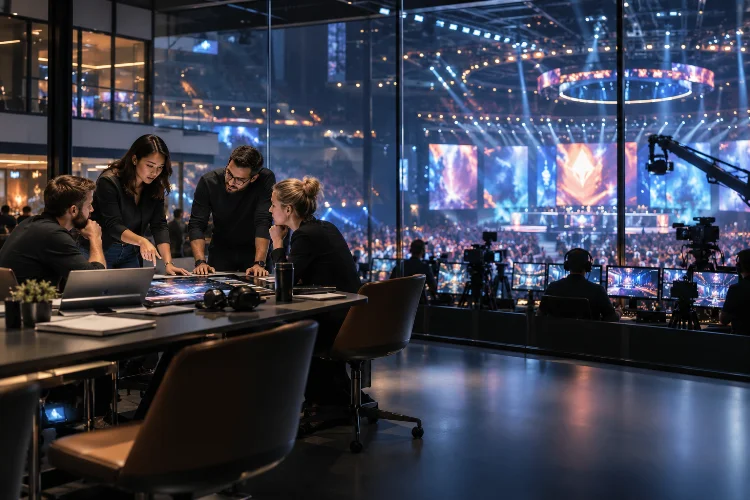
A packed arena, millions of online viewers, professional production crews, international teams, and a huge prize pool can make an eSports tournament look like a straightforward entertainment business.
Behind the broadcast, the economics are much more complicated.
Tournament organizers need to pay for venues, production, staff, technology, travel, hospitality, marketing, talent, and prize money while keeping events attractive to players, publishers, sponsors, platforms, and fans.
That makes advanced eSports tournament business models and revenue strategy increasingly dependent on multiple income streams rather than one major sponsor writing a large check.
The industry has been moving toward this approach for years.
Deloitte has highlighted sponsorship, competition-related revenue, publisher payments, ticket sales, media activities, and adjacent services as important parts of esports monetization, while also noting the challenge of converting large free audiences into paying customers.
The strongest tournament businesses therefore think less like one-off event promoters and more like media, entertainment, technology, and intellectual-property companies operating simultaneously.
1. Sponsorship Still Forms a Major Revenue Foundation
Sponsorship remains one of the most visible parts of tournament economics.
Brands can purchase naming rights, broadcast integrations, arena signage, sponsored segments, product placement, branded content, hospitality packages, and digital activations.
The important evolution is that successful organizers are selling more than logo exposure.
Sponsors increasingly want measurable audience engagement.
A technology company, for example, may sponsor tournament hardware and produce behind-the-scenes content. A consumer brand might create fan competitions, creator collaborations, or interactive arena experiences.
BLAST’s commercial operation currently includes sponsorship, media rights, destination partnerships, publisher relationships, ticketing, advertising, and digital revenue.
The company has also continued signing multi-year commercial partnerships around its Counter-Strike and Dota ecosystems.
This broader model makes sponorship more valuable because the brand can appear across several fan touchpoints rather than only during the live broadcast.
2. Media Rights Are Valuable but Work Differently From Traditional Sports
Traditional sports leagues have historically generated enormous revenue from exclusive television rights.
Esports has a different history.
Fans became accustomed to watching tournaments free on platforms such as Twitch and YouTube. Putting major competitions entirely behind paywalls could reduce reach and weaken the ecosystem.
That does not make media rights irrelevant.
Tournament operators can license feeds to regional broadcasters, local-language partners, streaming platforms, or television networks while preserving broad digital distribution.
ESL FACEIT Group openly markets media-rights licenses for its competitions, while BLAST has signed regional rights agreements covering specific languages and territories.
A 2025 BLAST agreement, for example, granted media rights for Brazilian and Latin American local-language broadcasts beginning in 2026.
The strategic question is therefore not simply, “Can we sell exclusivity?”
It is, “How much distribution value can we monetize without damaging audience growth?”
3. Digital Goods Can Connect Tournament Revenue Directly to Fans
One of esports’ biggest advantages is its connection to the games themselves.
Traditional sports cannot instantly sell a digital stadium skin, character cosmetic, weapon finish, emote, or team-branded item inside the sport being watched.
Game publishers can.
Riot has increasingly emphasized digital content as a core part of its esports sustainability model.
Its updated League of Legends structure shifts more attention toward revenue generated from esports-related in-game items and distributes that revenue through a Global Revenue Pool for participating teams.
Riot previously reported that the 2022 VALORANT Champions skin bundle generated $42 million, with half of the revenue distributed to participating teams.
This model is powerful because fans are buying something they can actually use inside the game.
Tournament operators without direct control over game economies cannot always reproduce this model independently, which makes publisher relationships extremely important.
4. Publisher Partnerships Can Change the Entire Economics
The publisher occupies a unique position in esports.
It owns the underlying game.
That means tournament organizers frequently operate under commercial, licensing, or strategic agreements that would have no direct equivalent in many traditional sports.
A publisher may fund part of a tournament circuit, provide prize money, authorize commercial rights, contribute in-game promotion, or hire an external operator to produce the entire competitive ecosystem.
BLAST’s expanding publisher relationships illustrate this structure. By late 2025, it had announced a multi-year partnership with Supercell to operate a refreshed Brawl Stars competitive program, including broadcasts, arena events, and commercial rights.
For organizers, this creates a B2B revenue layer separate from fans and sponsors.
The tournament company is not merely selling tickets.
It may also be selling production capability, league operations, audience development, broadcast expertise, and commercial infrastructure to the publisher.
5. Ticketing Works Best as Part of a Bigger Live Experience
Arena tickets generate direct consumer revenue, but ticketing alone rarely explains the economics of a global tournament.
Venues are expensive.
So are staging, security, travel, technical infrastructure, staffing, and broadcast production.
Live events therefore become more valuable when organizers monetize the audience in several ways.
A fan attending an arena tournament may buy a ticket, purchase merchendise, visit sponsor activations, upgrade to premium seating, spend on food and hospitality, and generate content that amplifies the event online.
This is why destination partnerships can also matter.
Host cities or tourism organizations may value a major gaming event because it attracts visitors and international visibility. BLAST describes destination and market-development relationships as part of its commercial strategy alongside sponsorship, media rights, ticketing, and publisher relations.
The physical tournament becomes both a revenue source and a marketing engine for the wider competition.
6. Revenue Sharing Keeps Teams Invested in the Ecosystem
Tournament organizers need strong teams.
Strong teams also need reasons to keep participating.
Prize money provides one incentive, but sustainable ecosystems increasingly use broader financial mechanisms.
Revenue sharing can distribute money from sponsorships, digital goods, media rights, or other commercial activities back to participating organizations.
Riot’s League model is one example. Its redesigned system combines fixed payments with digital-content revenue sharing and divides its Global Revenue Pool between general, competitive, and fandom-based allocations.
Tournament operators are experimenting too.
ESL FACEIT Group announced more than $22 million in financial contributions to the Counter-Strike ecosystem across 2025 and 2026, including annual funding directed toward participating teams and players alongside hospitality costs.
The business logic is straightforward.
If teams help create tournament value, part of the economic model should give them a reason to continue building that value.
7. Advertising and Branded Content Extend Beyond the Broadcast
Modern esports audiences consume much more than live matches.
They watch highlights, player interviews, short-form clips, creator streams, analysis shows, social media, podcasts, and behind-the-scenes content.
Every format creates another commercial surface.
ESL FACEIT Group currently positions its advertising business across live events, competitive platforms, creator content, streaming distribution, and gaming communities rather than relying solely on tournament broadcasts.
That approach matters because live tournament hours are limited.
Content can continue generating sponsor exposure before and after an event.
A tournament that lasts three days might support months of announcements, qualification stories, documentaries, interviews, social clips, and follow-up analysis.
The event therefore becomes the center of a much larger media cycle.
This makes content strategy part of the revenue strategy.
8. Build a Portfolio Instead of Depending on One Competition
Revenue diversification also applies across games.
A tournament organizer operating only one title is heavily exposed to that game’s popularity, publisher strategy, competitive calendar, and commercial rules.
Running several ecosystems spreads some of that risk.
BLAST, for example, has expanded beyond Counter-Strike into properties involving Dota 2, Rocket League, Fortnite, Rainbow Six, and publisher-led programs. ESL FACEIT Group similarly operates across numerous games, platforms, and event formats.
Diversification does not mean expanding randomly.
Every new title requires production expertise, publisher relationships, audience understanding, and commercial demand.
The best portfolio strategy reuses existing capabilities.
A production studio, sponsorship team, ticketing operation, sales department, broadcast technology stack, or venue relationship can sometimes support several tournaments.
That improves operating leverage.
9. Measure Fan Value, Not Just Viewer Numbers
A massive audience does not automatically create a profitable tournament.
What matters commercially is what that audience does.
Sponsors may care about engagement, geography, demographics, purchasing behavior, brand recall, or conversions. Publishers may care about player retention and game engagement. Teams may care about fandom growth and merchandise sales.
This is why audience analytics are increasingly important.
ESL has worked with measurement providers on standardized viewership, media valuation, sponsor exposure, and fan analytics to demonstrate commercial value to partners.
The smartest tournament businesses therefore measure more than peak concurrent viewers.
They want to know who watched, how long they stayed, which content they engaged with, whether they attended physically, and what commercial actions followed.
Better measurement makes partnership pricing more defensible and future revenue more predicatble.
10. Sustainable Models Need Multiple Revenue Layers
The strongest tournament economics rarely depend on one income stream.
A modern revenue stack might include sponsorship, media rights, publisher contracts, ticketing, hospitality, digital goods, advertising, merchandising, licensing, destination partnerships, and revenue from owned platforms.
Deloitte’s esports research has repeatedly highlighted the importance of diversification because sponsorship has historically carried a large share of industry revenue.
The goal is not simply adding more revenue categories.
Each stream should reinforce the others.
A larger audience attracts sponsors.
Sponsors help fund better events.
Better events improve content.
Better content grows fandom.
Stronger fandom increases ticketing, digital sales, merchandise, and commercial value.
That flywheel is much more resilient than relying on one sponsor or one media-rights contract.
Advanced eSports tournament business models are evolving from simple sponsorship-funded events into diversified entertainment ecosystems.
Successful organizers increasingly combine sponsorship, media rights, digital goods, publisher relationships, ticketing, advertising, licensing, destination partnerships, and revenue sharing.
The key challenge is balancing monetization with audience accessibility, competitive integrity, and long-term value for teams and publishers.
For tournament operators, the smartest starting point is to map every stakeholder and ask what measurable value the event creates for each one.
Then build revenue around that value instead of chasing isolated deals.
A sustainable tournament is not simply an event that attracts viewers. It is a commerical ecosystem where fans, teams, publishers, sponsors, platforms, and organizers all have reasons to keep participating.

